
|
|
#151
 06-18-2012, 10:41 AM
|
|||
|
|||

It's expensive but even more time consuming. Someone has to go through the pages and find out what's useful and what's not. But I guess for the TD members who do the research, it is a hobby anyway. There's also good support from a few community members.
Imho, it never hurts to read something. In the worst case it is junk, but then one at least knows where some folks get their funny ideas from. 
|
|
#152
08-05-2012, 10:33 PM
|
|||
|
|||
|
Quote:
m-82a have 5-7 min "forsazh" (in fact, sometimes, pilots used forsazh 10 and more min if this was need and sometimes kill engine, of course  )... )...forsazh for m-82a = nominal power m-82f, so la-5f's have good perfomance with 550-560 km/h at SL for good plane and without any really hard time limits (in tests F have some problems with cooling cylinders, but if you see "problems", this not mean problems not solved)... m-82fn can work on forsazh 10-15 min - this have in ALL la-5fn and la-7 manuals and you can see this here - "Взлетный режим - не более 10 мин" and "Температура головок цилиндров - 250° (не более 15 мин)"... EDIT after all i read FN-manual again, some things remembered, do some little research and what can say now - m-82fn, like m-82f, can work on forsazh all time of flight if aircraft have good cooling of engine (like with full or just open all "radiators" or in winter)... all veterans talk about this too... 10 min max for critical oil T and 15 min max for critical cylinders T from manual, with or without some cooling, this is limits for one use without serious after-effects... and phrase "Взлетный режим - не более 10 мин" - maybe this is what i write about temperatures, maybe it's + and next thing - resource of m-82fn was 100 hours (or something like this), and engine only 6 hours from 100 can work on forsazh... of course, can more, but in this case engine need to be repaired or he not work good all 100 hours... so, this is cautions for long life of engine and cautions for one sort of pilots ("культура эксплуатации двигателя")... so, something like this... maybe i somewhere little wrong, maybe no (i think no), sorry for mistake if what... Last edited by 1984; 08-07-2012 at 12:21 PM. Reason: details...
|
|
#153
11-30-2012, 03:50 PM
|
|||
|
|||
|
In response to several posts concerning the new drag profile of the FW190 and the suggestion that a test be carried out, I have produced the following results of deceleration rates and ROD's in the landing config. versus the Bf109
They are in no way scientific, but do show that there may be an issue with the current coefficient of drag setting applying to the whole flight envelope including rates of descent in the landing config. I do believe that the current settings provide a good dogfighting FM and in no way would it be necessary to change that. However, some tweaking of the drag coefficient to produce more drag in the landing config. may add to realism as currently it does seem to be a little in error. Nicholaiovitch Here are the results of the suggested tests:- Please note error in ROD:- Should be "mpm" (metres per minute) not "mps" (metres per second) 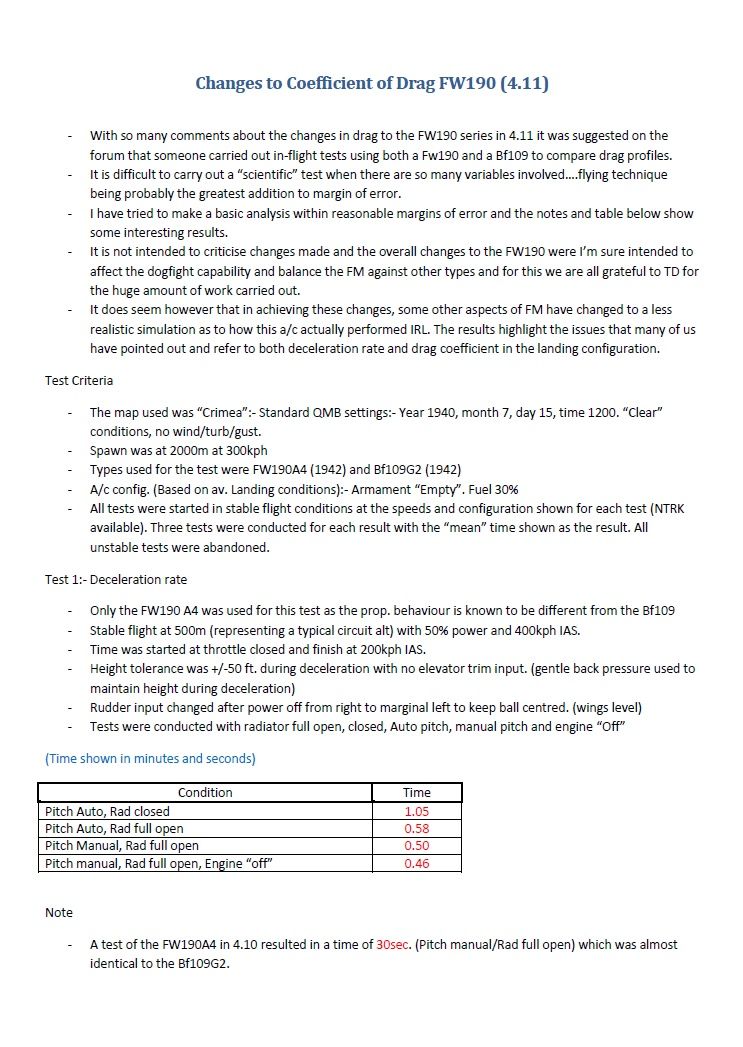 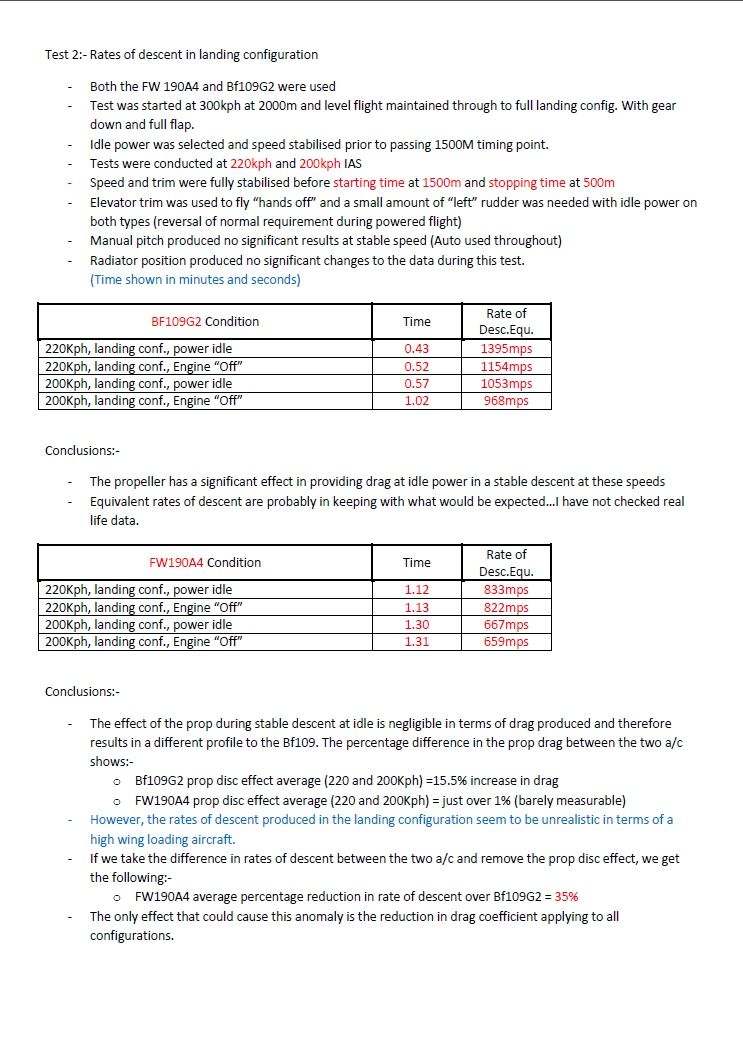
Last edited by Nicholaiovitch; 11-30-2012 at 04:19 PM. Reason: Error
|
|
#154
11-30-2012, 05:28 PM
|
|||
|
|||
|
Thanks for going the length to do the testing and preparing the results in an attractive way.
It appears that compared to real life procedures for the 109, the 109 is totally off the mark, the 190 being more reasonable. We get a glide ratio of ~1/3 for the 109 and ~1/5 for the 190.
|
|
#155
11-30-2012, 07:47 PM
|
|||
|
|||
|
start-Notleistung= emergency combat power (1/42ATA)
steig/kampfleistung= climb/continous max power (1/32ATA) now about the REAL boost on A5 and forward: The following text has been copied from a private Forum several years ago but it seems i fracked up the file and only have a part of the whole text.  Source 801D boost or C3-Einspritzung Increasing Knock Limited Performance in the BMW801D2 Part 1 Throughout the war, the BMW801D2 was continually developed to keep pace with the performance of the allied fighters faced by the FW-190 equipped Geschwaders. The engine became a reliable workhorse and made the FW-190 one of the best performing low altitude fighters of the war. It began its design lifecycle with a top shaft output of 1670PS at Start u Notleistung at 1st Gear supercharger full throttle height and gained 150 PS by wars end at the same settings. Additional boost systems raised this power output to over 2100PS. The BMW801D2 was developed to the limits of its potential and even beyond a point when other motors such as the BMW802 showed greater promise for a similar effort. The Achilles heel however continued to be high altitude performance. This article in two parts will discuss the 4 major systems used to increase knock-limited performance in the BMW801D2 above the engines normal Start u Notleistung rating. --------------------------------------------------------------------------- In June of 1942 BMW completed a theoretical investigation in the potential development of the motor. Without any major change to the motor it was possible to increase shaft power output at full throttle height by 40PS at Start u Notleistung and 110PS at Steig u Kampfleistung. With some major changes it was possible to get a shaft output of 2000PS without additional knock limiting performance enhancements. It was determined that the motor had the potential for developing between 2000PS-2200PS by injection of knock limiting agents such as water or alcohol water mixtures. Work began immediately on putting the theory into practice. Prototype motors were constructed and work began on improving the power output of the motor at all levels. By July 1942 BMW had constructed several prototype motors to begin laboratory bench testing. BMW801D2V15 achieved 1950PS shaft output without ram or knock limiting performance enhancements during this phase. In the quest for attaining the full potential of the BMW801D2 three knock limiting agent injection systems and one method of oxygen enrichment of the charge were shown to be practical or worthy of further investigation. ---------------------------------------------------------------------------- C3-Einspritzung, The Bomber and Attack Pilots Insurance The first system to see operational adoption was the injection of C3 fuel as a knock limiting agent directly into the left side of the supercharger intake. Motors were modified with stronger pistons adopted from the BMW801E/S development. These new pistons became the production standard on all BMW801D series motors in June 1943. On the 10th of April 1943 the first flight testing of the new system began with a 25-minute flight in the low altitude portion of the 1st gear supercharger and resulted in 8 minutes of the systems use. By the 22nd of April 1943 test flights were using the system as long as 15 minutes and at manifold pressures as high as 1.8ata between 3.5km and 7km altitude. Initial flight-testing was completed on the 17th of May 1943. The flight test results concluded however that the system produced 2050PS in the 1st Gear Supercharger and that a manifold pressure of 1.65ata could be used reliably. As the pressure fell off with altitude however, the standard fuel pump was not able to provide sufficient quantities of fuel to allow the system to develop additional power in the 2nd Gear Supercharger. The engine cooling was also not sufficient enough for the system to be used in climbing flight. The fuel pump could not deliver enough fuel to the left hand supercharger intake to keep cylinder temperatures within operational limits at climbing speeds. It was felt that a further 50PS of thrust power could be gained by changing the propeller reduction gearing to a more suitable ratio in order to fully exploit the new power gains of the motor. The initial testing was completed and the findings compiled by the 19th of July 1943. It is interesting to note that JG54 begins reporting experience with the new system in 23 July 1943. This point..(text missing) So, there are actually 2 different versions Phase1: Low alt 1.58ATA (1000m max with standard fuel-pump) from june43 to end 43 Phase2: Full 1.65ATA on both Charger's gears from End 43. And this system was as it seems used on all versions afterwards 
|
|
#156
11-30-2012, 08:54 PM
|
|||
|
|||
|
Quote:
- Stable flight, 260-270kph (best L/D speed), radiator closed, engine "Off" gives 1minute 42sec to lose 1000m (same conditions as in previous test) - This gives the Bf109G2 FM a glide ratio of 12.78:1 (as published on the net) - Test of the Fw190A4 with 4.11 FM (same L/D speed quoted) and same conditions gives 1minute 56sec to lose 1000m. - This gives the Fw190A4 new FM a glide ratio of 16.52:1.......Is that correct? Nicholaiovitch
|
|
#157
12-01-2012, 04:50 AM
|
|||
|
|||
|
Wait - 270 km/h = 75m/s.
Bf 109 - 102 seconds to lose 1000m - 7650m distance / 1000m altitude = 7.7 Fw 190 - 116 seconds to lose 1000m - 8700m distance / 1000m altitude = 8.7 You had me scared there for a minute, 16.5 would be way too high. Even 12.8 sound like a very good figure for a plane like the 109.
|
|
#158
12-01-2012, 08:41 AM
|
|||
|
|||
|
Quote:
http://www.adlerhorst-hangar.com/emil-91.html Nicholaiovitch
|
|
#159
12-01-2012, 10:48 AM
|
|||
|
|||
|
Certainly an interesting account. Messerschmitt polars for the 109 E show a optimum L/D of about 10, at a Cl of around 0.5. I'm more inclined to stick with that figure than with Bob's. Focke Wulf gives L/D max of around 11 for the Fw 190A. Unfortunately I couldn't find polars for the flaps down configuration.
Both figures show a bit of a variance, so +- 1 is easily possible, but at any rate, I guess we can agree that the in game glide ratio as measured by you is (way) too low. I'll try to do my own test soon and will see if I can confirm your findings, it might help to reduce speed a bit.
|
|
#160
12-01-2012, 11:59 AM
|
|||
|
|||
|
Basically I can confirm your findings. I'm getting the 109 to about 1:8, the 190 to about 1:9. I think one difference between the real plane and the in game representation is the lack of a fully featherable propeller, this could improve glide ratio quite a bit.
Anyway, what does it tell us about the realism of the landing characteristics, or more specifically the glide characteristics with flaps and gear down? Personally I see no reason to consider the STOL characteristics of the 109 more realistic than the 4.11 190.
|
 |
|
|


 Linear Mode

