
|
|
#211
 09-19-2012, 03:15 AM
|
|||
|
|||

Quote:
http://www.wwiiaircraftperformance.o...oct40-pg22.jpg So Gates was also using an unusually powerful 109 for the chart as well. I suspect it was probably an experimental high-altitude 109E. Question is what data did Crumpp use to compile his chart? There's no engine rating shown, no take of weights, nor anything else to indicate on what basis Crumpp's "calculations" were made. For any proper analysis Crumpp's chart is totally useless. 
|
|
#212
09-19-2012, 03:46 AM
|
||||
|
||||
|
Quote:
Here it is too, right off the spreadsheet: Spitfire Mk I Aircraft Data weight 6050lbs Power 990bhp Level speed 247KEAS Propeller efficiency 0.8 Wing area 242 sqft wing efficiency 0.85 Dynamic pressure 206.8101695psf Aspect Ratio 5.6 Mass 187.8881988 ft/s^2 Bf-109E-3 Aircraft Data weight 5580lbs Power 990bhp Level speed 269KEAS Propeller efficiency 0.85 Wing area 174.9 sqft wing efficiency 0.85 Dynamic pressure 245.2915254 Aspect Ratio 5.77 Mass 173.2919255 ft/s^2
__________________

Last edited by Crumpp; 09-19-2012 at 03:59 AM.
|
|
#213
09-19-2012, 03:59 AM
|
||||
|
||||
|
Quote:
They did a lot of estimating off very few data points. The CLmax for both aircraft closely matches the full flaps CLmax and not clean configuration.
__________________
|
|
#214
09-19-2012, 04:33 AM
|
|||
|
|||
|
Quote:
Well clearly you haven't read AVIA 6/2934 They had reasonable data on the aircraft in question. AVIA 6/2934 is based on actual flight test of a BF109E3 in RAF hands. Here is AVIA 6/2934 summary of turn performance based on Flight tests and calculation : 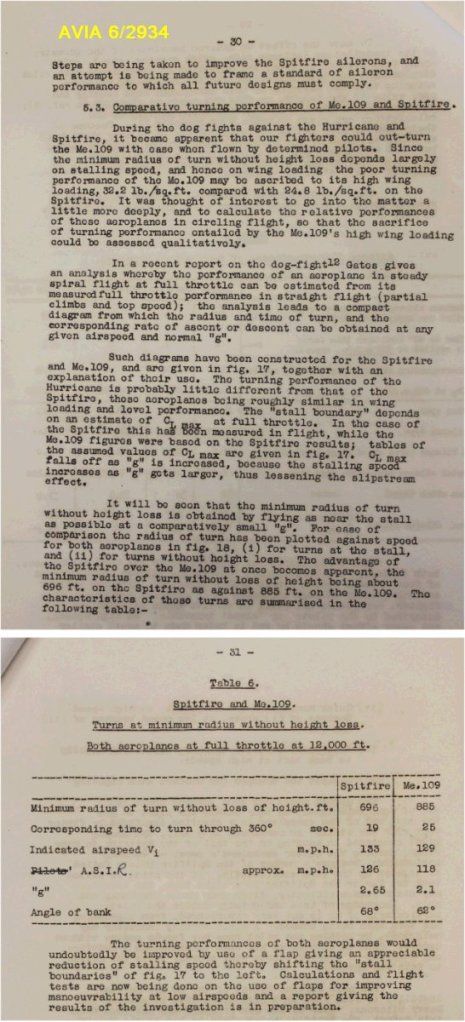 So the RAE determined the opposite to you based on flight test and calculation.
|
|
#215
09-19-2012, 06:50 AM
|
|||
|
|||
|
Quote:
__________________
Il-2Bugtracker: Feature #200: Missing 100 octane subtypes of Bf 109E and Bf 110C http://www.il2bugtracker.com/issues/200 Il-2Bugtracker: Bug #415: Spitfire Mk I, Ia, and Mk II: Stability and Control http://www.il2bugtracker.com/issues/415 Kurfürst - Your resource site on Bf 109 performance! http://kurfurst.org 
|
|
#217
09-19-2012, 07:02 AM
|
|||
|
|||
|
Quote:
Just to make it clear I don't doubt the Spit had a sustained turn advantage at lower speeds, but OTOH I am pretty sure the situation reverses at higher speeds (for the 6 1/2 lbs version) at lower altitudes, since the 109E has both less drag and more power. I am also curious about the effect of the two speed prop on turn capacity. Having 990 HP at the prop shaft is nice, but its all for naught if the two pitch prop can't properly convert it into thrust at turning speeds.
__________________
Il-2Bugtracker: Feature #200: Missing 100 octane subtypes of Bf 109E and Bf 110C http://www.il2bugtracker.com/issues/200 Il-2Bugtracker: Bug #415: Spitfire Mk I, Ia, and Mk II: Stability and Control http://www.il2bugtracker.com/issues/415 Kurfürst - Your resource site on Bf 109 performance! http://kurfurst.org
|
|
#218
09-19-2012, 07:48 AM
|
|||
|
|||
|
The RAE chart shows a Spitfire sustained turn advantage across the entire speed range from the Lift limit through to the max 1G sustained speed of around 340mph.
i.e. if the "Angle of straight climb" (Ps=0) for both the Spitfire and BF109 were overlayed on the same chart the Spitfire angle of straight climb would be above the 109 line from the Lift limit through to 1G Vmax. So at any speed in this range the Spit can sustain a higher G according to the RAE .... but not according to the Crumpp plot ... at any speed. Both aircraft in this chart having similar values of 1g Vmax at the charted altitude. There is no mention of prop type in the AVIA report for either the Spitfire or the 109. I take your point on propeller efficiency though ... that is touched on in another AVIA report (AVIA 6/13805) in which the RAE believe the 109 and Spit prop efficiency was essentially the same at 10,000ft with the 109 around 3% better at 15,000ft.... though with caveats. 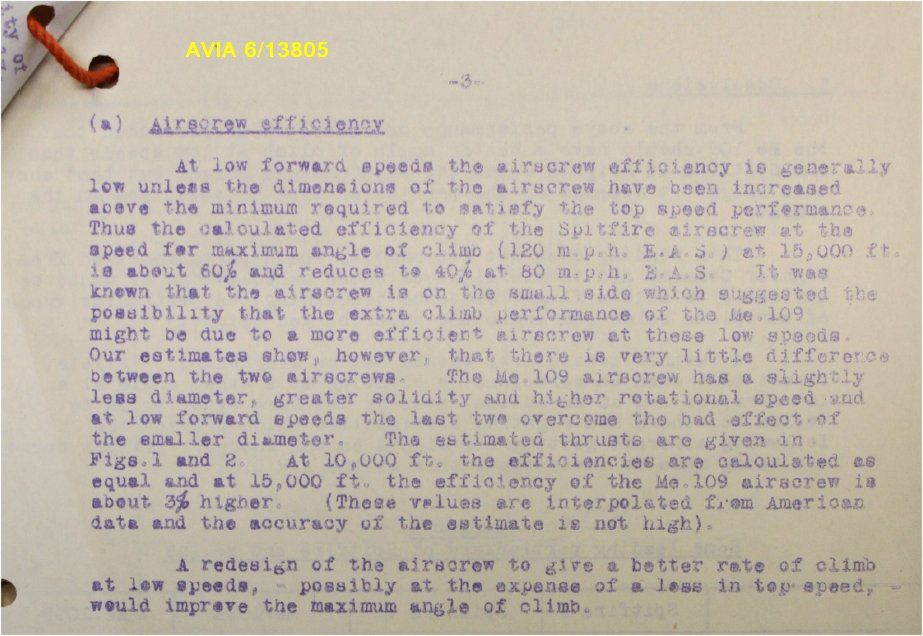
Last edited by IvanK; 09-19-2012 at 07:56 AM.
|
|
#220
09-19-2012, 09:02 AM
|
|||
|
|||
|
Quote:
|
 |
|
|



 Linear Mode

