
|
|
#1
 08-29-2012, 10:18 AM
|
|||
|
|||
 Spit/109 sea level speed comparisons in 1.08 beta patch
Since there is a bit of current interest in FMs, I did some quick sea level tests for the current beta patch (1.08 ), and compared to generally accepted real life performance. As patches could change any time I didn't want to spend much time doing full speed vs alt tests.
These are the tests (with real life data): 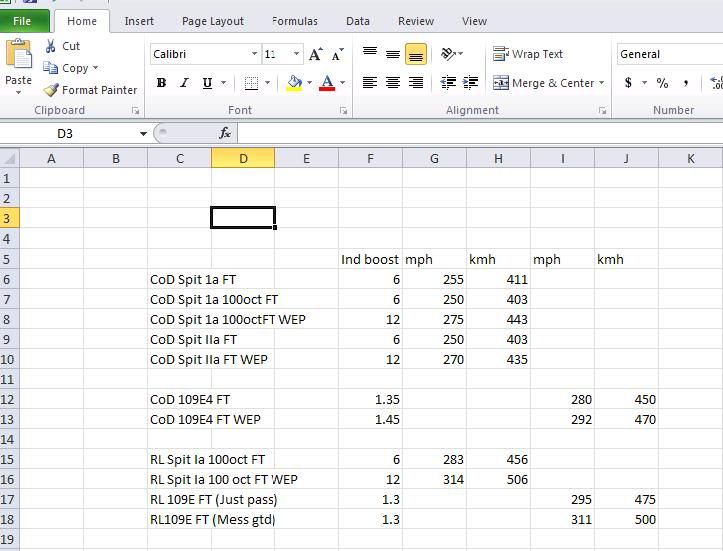 My Spit CoD data is using 2700rpm (full boost) instead of 3000rpm to postpone engine failure and allow speed testing. This is not so much of a problem as there does not seem any speed increase from 2700-3000 rpm anyway. Rads full open, canopy closed (although speed effects from these are negligible to nonexistant). The 109E4 uses auto prop pitch, oil and water rads open. For real life data, the RAE Spit I data is pretty well accepted (although speeds are a little high due to lack of pilot armour and IFF equipment). The real life 109 is a bit difficult, I started a thread on 109 performance a while back and argued that actual 109 performance at sea level was likely to be approximately on the pass/fail mark on the Messerschmitt official specification (475kmh) based on what flight tests were available. Kurfust disagreed and maintained that the appropriate value is 500kmh at sea level (average of Me official spec), which is a defensible position. http://forum.1cpublishing.eu/showthread.php?t=32259 I think for the sake of CoD using the 500kmh@SL for the 109 would be reasonable, might save a few arguments and work well in multiplayer if it was implemented. For graphing purposes I plot both 475kmh@SL ("close pass") and 500kmh@SL ("average Me guaranteed") 109s. 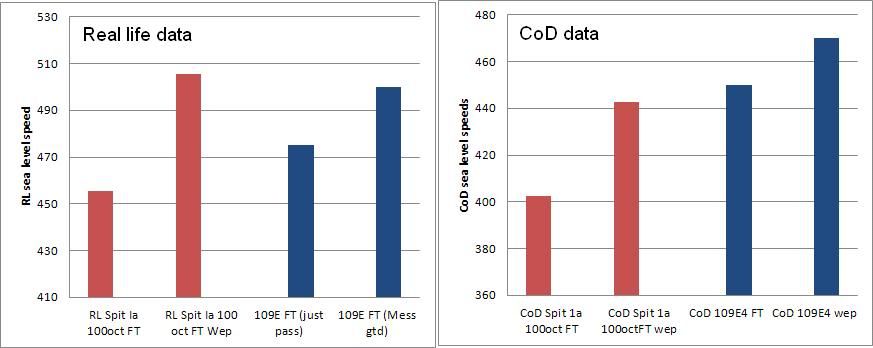 From the real life data, the 87 octane Spit I (or 100 octane but not using "WEP") was slower than both the 475kmh and 500kmh 109Es. Using the 100 octane +12psi boost, the Spit was faster than the 475kmh 109 but about the same speed as the 500kmh 109E. So taking the 500kmh 109E as a good fit for CoD, we are looking at approximate speed parity for 100 octane Spits and 109s going all out on the deck. Besides the fact that all speeds are around 50kmh low, the current CoD data is a bit dire in this respect when looking at relative 109/Spit speeds. It's not too bad just looking at the Spit Ia at +12psi versus the 109 at 1.35ata (5 min limit), with both aircraft at about the same speed (similar to real life Spit + 12psi and "official spec" 500kmh 109). However, there are two big catches. * First, the CoD 109 has access to it's historical 1 min takeoff only boost (1.45ata), and can use it (unhistorically) practically continuously with no engine problems. This allows it to go 20kmh faster than the CoD Spit all out at +12psi. * Second, the CoD Spit has extremely time limited access to +12psi without blowing the engine. So very quickly, the Spit will have to turn off the boost cutout and drop back to around 400kmh. The CoD 109 is now 70kmh faster at SL if it continues to keep activating 1.45ata. However it doesn't need to bother as without it is still 50kmh faster than the CoD Spit stuck back at +6psi. Some quick tests on turning off temp effects are interesting, this increases the SpitIa 100octane speeds by about 10mph/15kmh but doesn't affect the 109. Clearly the temperatures that the Spits run at decrease engine output even when the engine does not fail, which does not occur in the 109. With temp effects off the Spit can maintain +12psi continuously at around 460kmh, against the 470kmh of the 109 using 1.45ata. It would be rather hard on the 109 driver having to continuously press his 1.45ata while the Spit driver can select +12psi and leave it on though! It would be closest match to historical performance we could get without FM revision though (at least at sea level!) camber 
|
|
#2
08-29-2012, 10:40 AM
|
|||
|
|||
|
Quote:
1)As shown below, the Merlin was more than capable of running for extended periods at +12 lbs boost (paragraph 4 8 hrs at +12 lbs, terminated by a glycol leak, a problem which was solved by a redesign of the head): Merlin engines should not be overheating or failing almost as soon as the 5 minute limit is up, there needs to be far more leeway than has been given. 2)I have not yet tested the Defiant or Hurricane but, as shown by ACE-OF-Aces, and below, the CLOD Spitfire performance figures do not match real world performance. 
|
|
#3
08-29-2012, 10:50 AM
|
|||
|
|||
|
Quote:
The graphs having different scales makes it very hard to compare, any chance of putting it all on one graph? - Or at least the same scaled graph? FT = Full Throttle? I think nearly all the speed tests on the 109 were done at 1.3 or 1.35 Ata were they not? Not full throttle... Last edited by 5./JG27.Farber; 08-29-2012 at 11:03 AM.
|
|
#5
08-29-2012, 10:58 AM
|
|||
|
|||
|
Quote:
Climbing yes but all out power no. And I agree also about boost being used as often as you like in the 109...not true and I think this cones from pilots that don't fly it, do it high Altitude continuously and see what happens, so it continuously on max pitch and full throttle with low speed and your kill it too..
|
|
#6
08-29-2012, 11:02 AM
|
|||
|
|||
|
Quote:
__________________
Il-2Bugtracker: Feature #200: Missing 100 octane subtypes of Bf 109E and Bf 110C http://www.il2bugtracker.com/issues/200 Il-2Bugtracker: Bug #415: Spitfire Mk I, Ia, and Mk II: Stability and Control http://www.il2bugtracker.com/issues/415 Kurfürst - Your resource site on Bf 109 performance! http://kurfurst.org 
|
|
#7
08-29-2012, 11:17 AM
|
||||
|
||||
|
Quote:
the 5 minute limit 'has' to be a guaranteed absolute minimum in order to be an allowed limit, the likelyhood of failure 'at' 5 minutes is low and increases proportionally with time beyond the 5 minutes, I don't care if the failure rate is 100% at 6 minutes it's just highly unrealistic to have guaranteed failure at 5:01.
__________________
 Intel Q9550 @3.3ghz(OC), Asus rampage extreme MOBO, Nvidia GTX470 1.2Gb Vram, 8Gb DDR3 Ram, Win 7 64bit ultimate edition
|
|
#8
08-29-2012, 11:28 AM
|
||||
|
||||
|
Quote:
Given that combats usually last only a few minutes it should not be a problem too often. Its true though that information on the maximum time before failure needs to be found or, perhaps more correctly, information that will allow the devs to simulate properly the temperature effects of BCO and then, presumably, the temperature effects on the engine will already have been modelled....... ermmmm I say the latter with my tongue in my cheek.
__________________
klem 56 Squadron RAF "Firebirds" http://firebirds.2ndtaf.org.uk/  ASUS Sabertooth X58 /i7 950 @ 4GHz / 6Gb DDR3 1600 CAS8 / EVGA GTX570 GPU 1.28Gb superclocked / Crucial 128Gb SSD SATA III 6Gb/s, 355Mb-215Mb Read-Write / 850W PSU Windows 7 64 bit Home Premium / Samsung 22" 226BW @ 1680 x 1050 / TrackIR4 with TrackIR5 software / Saitek X52 Pro & Rudders
|
|
#9
08-29-2012, 11:33 AM
|
|||
|
|||
|
Quote:
|
|
#10
08-29-2012, 11:41 AM
|
|||
|
|||
|
Quote:
As I understand the reason for Merlin engine failures in CLOD are probably related to: a, Exceeding oil and/or coolant operating temperatures of the Merlin. Obviously engine failure is a very obvious conseqence of too high temperatures, so the real question is IMHO aa, how long the Spit / Hurri could be run at + 6 1/4 ab) how long the Spit / Hurri could be run at + 12, which is about 30% more power/heat load. b, Fall of oil pressure during negative-g manouvers, resulting that the engine is insufficiently lubricated, which can and will destroy an engine in very short order, any engine, and should be correct for the 1940 neg-g sensitve Spit/Hurri (which's manual specifically warns against negative-g and low oil pressure conditions), so I sense that Red pilots not knowing/ignoring this limitation may be at the culprit.
__________________
Il-2Bugtracker: Feature #200: Missing 100 octane subtypes of Bf 109E and Bf 110C http://www.il2bugtracker.com/issues/200 Il-2Bugtracker: Bug #415: Spitfire Mk I, Ia, and Mk II: Stability and Control http://www.il2bugtracker.com/issues/415 Kurfürst - Your resource site on Bf 109 performance! http://kurfurst.org
|
 |
|
|




 Linear Mode

