
|
|
#1
 06-05-2012, 03:41 AM
|
|||
|
|||
 Spit IIA Speed in game test
Attached graphic is my Speed test in CLOD current version + Hot fix.
Blue Line my results, Broken line Spit I spec, full line Spit II spec METHOD Each run commenced on altitude with stabilised Oil/Rad temps Oil Temp at 80deg C. Rad Full open (At present I cannot detect any Rad drag so radiator position is not relevant imo) Each altitude was a specific FMB set up. Altitude maintained +-50ft throughout the test. QNH checked as 992mb on the specific map used. Each run done 3 times and Vmax average plotted. Seal level temp estimated 19 deg C based on HEIII OAT gauge on the same map on the ground. TAS calculation based on standard 2 deg C lapse rate from the surface. so at 16,000ft I was using an OAT of -13deg C My test wt 114lbs less as reported by FMB than the spec wt Power setting was Full throttle 3000RPM. Indicated Boost +6. Now its important to understand that displayed Boost is not I believe actually measured in the FM but represents an angular animation value. We all know that it should be indicating +9 in the Spit II. I gave up testing at 17,000ft as things were radically different from the spec values. Results plotted as accurately as I could. 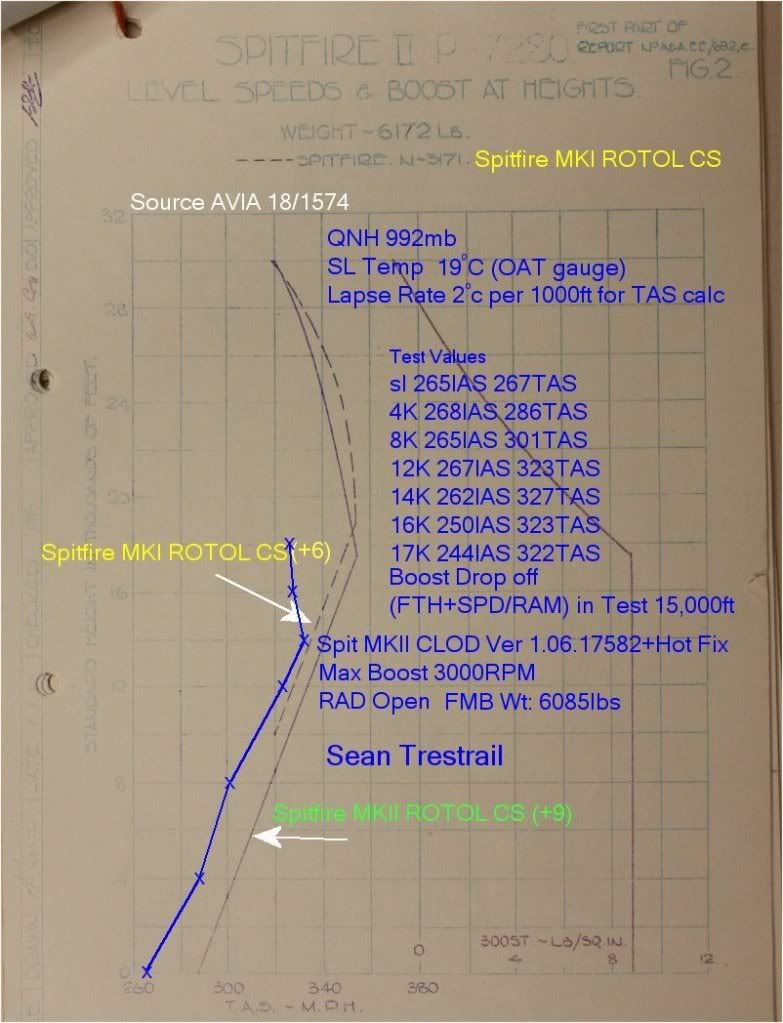 If someone wants to convert the test values to Standard day figures ... go for it. Last edited by IvanK; 06-05-2012 at 04:06 AM. |
|
#2
06-05-2012, 06:36 AM
|
|||
|
|||
|
A note about the test method. I think it would be possible to get the top speed by measuring the movement of the aircraft over the ground by a mission script.
About the test result. It just makes me sad but to be honest it doesn't surprise me at all. Could you do 2 reference values with "emergency boost" at see level and one at FTH? Out of curiosity, was there are large difference between the 3 test runs? Last edited by 41Sqn_Banks; 06-05-2012 at 06:59 AM. |
|
#3
06-05-2012, 07:53 AM
|
|||
|
|||
|
there was very little diff on each run in the order of +- 2Mph max IAS as far as I could interpolate on the ASI. Each run was flown like a precision Instrument Flying exercise.... actually better than the +-50ft tolerance I quoted.
I will do some runs as requested with Boost cutout as well. Same for the Hurricane test which I have just posted as well. Distance covered over the ground would provide Ground Speed. Working back to get TAS might be an issue as we really dont know the atmospheric model. I know the QNH is accurate but the base Sea level temperature is based on OAT with a static observation of the OAT gauge. In other tests at various altitudes in climb and descent (I was trying to map the lapse rates used in the CLOD atmosphere) I was getting some very strange OAT values ... to the point I gave up. Last edited by IvanK; 06-05-2012 at 07:58 AM. |
|
#4
06-05-2012, 08:31 AM
|
|||
|
|||
|
Same Basic Mission.
Spit IIA Sea Level Boost Cutout activated 3000RPM Boost indicates Full scale deflection I achieved 285IAS/287TAS At 15,000ft which is the CLOD +6.25 FTH (with RAM) with boost Cutout activated Boost remained at +6.25Lbs I achieved 258IAS/328TAS Dropping down to 12,000feet which is where with Boost Cut out the Boost starts to drop from Full scale deflection (+ 8 ) I achieved 267IAS/323 TAS ... same as with out Boost cutout. Last edited by IvanK; 06-05-2012 at 10:21 AM. |
|
#5
06-05-2012, 10:10 AM
|
|||
|
|||
|
Concur.
My test scores (post patch) from previous thread: Spit IIa FTH = 13500 ft (?!) at 6.25psi, 2750rpm (rad open) engine fails after about 3 mins 260mph IAS@13500 = 328mph TAS = 528 kmh TAS Pretty much exactly as yours for 14000 ft. Except your engine seems to stay a bit cooler and my merlin a bit more fragile 
|
|
#6
06-05-2012, 11:17 AM
|
||||
|
||||
|
Quote:
I'm not an aviation expert but google was my friend so if the following is wrong well, just say so. I took the CoD MkII I.A.S. as 'good' and equal to Calibrated Airspeed CAS (assumed no position errors etc). I held ROC as near zero as possible but its a b*tch to trim on my rotary but I took representative data from a consecutive set of near-zero ROC data. I ran with Rad open at max boost and max rpm (scripted out as 2990-2992) although the A&AEE tests used 2850 and I never achieved their 8.8 boost although it did creep up with altitude. The Altimeter can only be set in whole millibars so can't be set accurately (about 15ft out at SL, 430ft at 10,000) but I used it because the pressure altitude calculation uses the mb set in the Alltimeter. I got the true height from Script but did not use it so that's a point of contention. I took formulae from here:- http://williams.best.vwh.net/avform.htm#Mach and... I used TAS = CAS/(1-6.8755856*10^-6 * D_Alt)^2.127940 ... where D_Alt is Density Altitude for <36,089.24ft) I used Density altitude (D_Alt) = P_Alt +(StdTemp0/.0019812)*(1-(StdTemp0/OAT)^0.2349690) ... where StdTemp is 273.15K, OAT is scripted out Temperature (290k dropping to 270k) and P_Alt is Pressure Altitude = Indicated_Alt+145442.2*(1- (alt_set/1013.25)^0.190261) ... and alt_set was 995mb which is the nearest I can set it for the true height of Tangmere airfield (39.1ft True from script vs 25.46 indicated. I happen to know Tangmere is about 12.5m/39ft.) Don't be fogged by 'science', if I got it wrong just say so, otherwise here's the chart showing CoD Spitfire MkII TAS vs A&AEE MkI and MkII data for a standard day.
__________________
klem 56 Squadron RAF "Firebirds" http://firebirds.2ndtaf.org.uk/  ASUS Sabertooth X58 /i7 950 @ 4GHz / 6Gb DDR3 1600 CAS8 / EVGA GTX570 GPU 1.28Gb superclocked / Crucial 128Gb SSD SATA III 6Gb/s, 355Mb-215Mb Read-Write / 850W PSU Windows 7 64 bit Home Premium / Samsung 22" 226BW @ 1680 x 1050 / TrackIR4 with TrackIR5 software / Saitek X52 Pro & Rudders |
|
#7
06-05-2012, 12:11 PM
|
||||
|
||||
|
And this is the 'best' fighter in the RAF too.
I too noticed the FTH was way lower than IRL for all types. I also find that the climb rate are particularly inaccurate, once you get over 16kft you'll struggle for 500fpm in the Hurricane. In the Spitfire I find it ironic that it is supposed to outperform the 109 @ 6000m now (20kft) BUT the climb rate above 16kft is so bad that getting there takes forever. I don't think it's an optimum altitude for the Spitfire in game anyway, it's just that the 109 fails by even more @ that alt. It beggars belief that a company that set out to build a combat flight sim has no idea about the performance and operation of the aircraft they are supposed to be simulating, and appears to have no database of data of their own on which to model it all, instead relying on being shouted at by their own customers. To cap it all there is a databse of bugs, formally raised and set up by dedicated customers which they do know about, but I have little faith that they've paid any attention to. I run a squadron of about 30+ pilots, we get barely any even turning up now. What do I do? |
|
#8
06-05-2012, 12:29 PM
|
||||
|
||||
|
I've also found a pronounced difference in FM for the Spitfire IIa between offline and online. The two FM's are the same at SL, but I found the IIa's online FM takes a remarkable departure from the offline FM as altitude increases.
__________________
|
|
#9
06-05-2012, 01:10 PM
|
|||
|
|||
|
Hello Ivank!
I made some tests for the 109 until 4000m (1.3 ATA and around 2280 RPM, rads open). I do not tried the Spits because i am not used to it. I am assuming an error in speed of +-10Km/H and in altitude of 50 meters. The following results: 100m/sea level: 410 km/h IAS 1000m: 420 Km/H IAS 2000m: 430 Km/H IAS 3000m: 430 Km/H IAS 4000m: 410 Km/H IAS This matches very well your speed found for the spit. Should be interesting gather data from diferent pilots when calculating the average since it one had a different flying hability. After i ll test the 109 for higher altitude. I suggest you create a method of testing and put it here. Then all pilots can contribute making tests following the method and send info to be gathered. This way we can use many observations and reduce the error and the same time no one had big work repeating the tests. And i guess it is much better and informative gather data from different guys. My guessing is that this guys stating that 109 can outfly the Spit easily in CloD is simply because they are flying wrong, most of time they are simply whirlwinding down there in the deck. I barely can see a spit above 4000m. The want to zip zap when engaged by a 109 with energy advantage then climb like a rocket on its sixs and shot them down. Obviously a 109 coming out of dive will outclimb. The acs aremb them easily very well matched. Last edited by Ernst; 06-05-2012 at 01:21 PM. |
|
#10
06-05-2012, 01:22 PM
|
|||
|
|||
|
Quote:
I have tracks if you want them. |
 |
|
|



 Linear Mode

