
|
|
#541
 03-09-2012, 12:28 PM
|
|||
|
|||

Quote:
|
|
#543
03-09-2012, 12:44 PM
|
|||
|
|||
|
Quote:
Even you gospel, FLIGHT, says the early Merlin was ran at 22lb boost. |
|
#544
03-09-2012, 12:51 PM
|
|||
|
|||
|
Quote:
If they didn't mention that beefing up the eng was necessary, isn't it more logical to think that it's due to the fact that no 100 oct was actually used as a prime source of fuel ? 
|
|
#545
03-09-2012, 01:02 PM
|
|||
|
|||
|
Alec Harvey-Bailey, The Merlin in Perspective, (Rolls-Royce Heritage Trust, Derby, 1983)
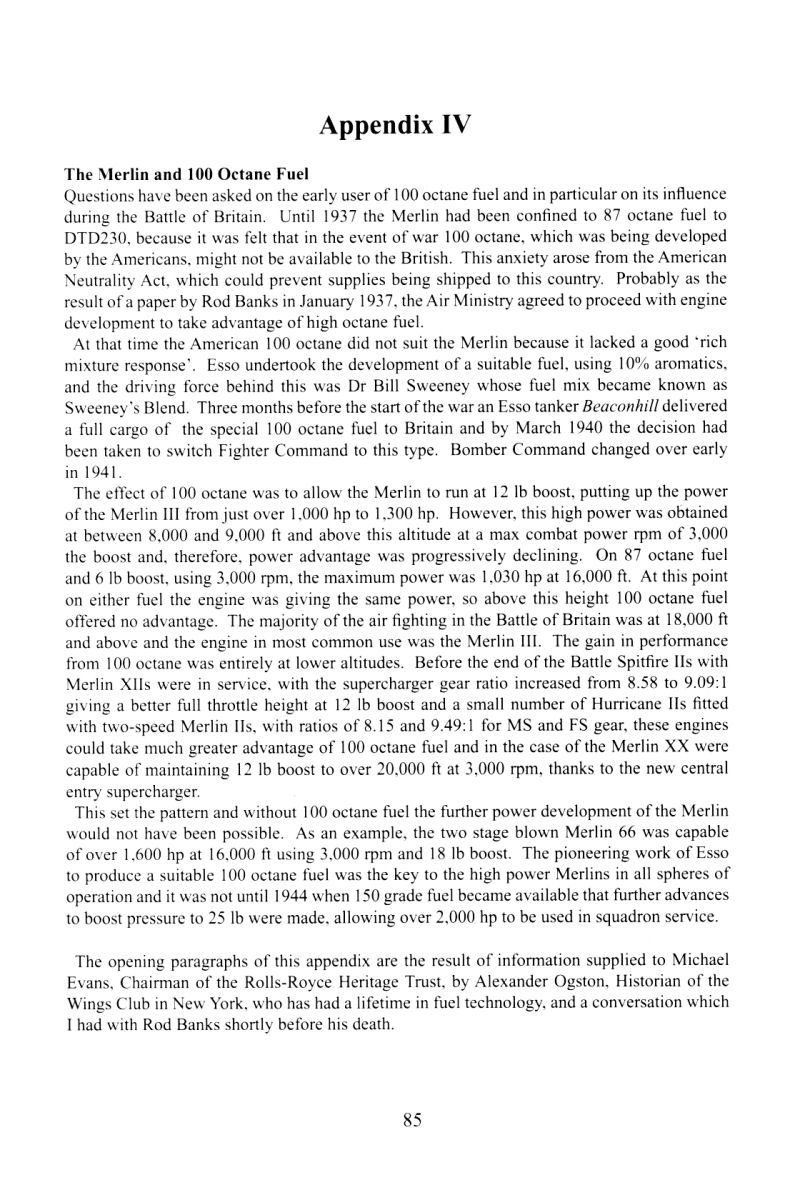 W.G. Dudek and D. R. Winans, excerpt from AIAA Paper No. 69-779, Milestones in Aviation Fuels, (Esso Research and Engineering Company, New York 1969.) 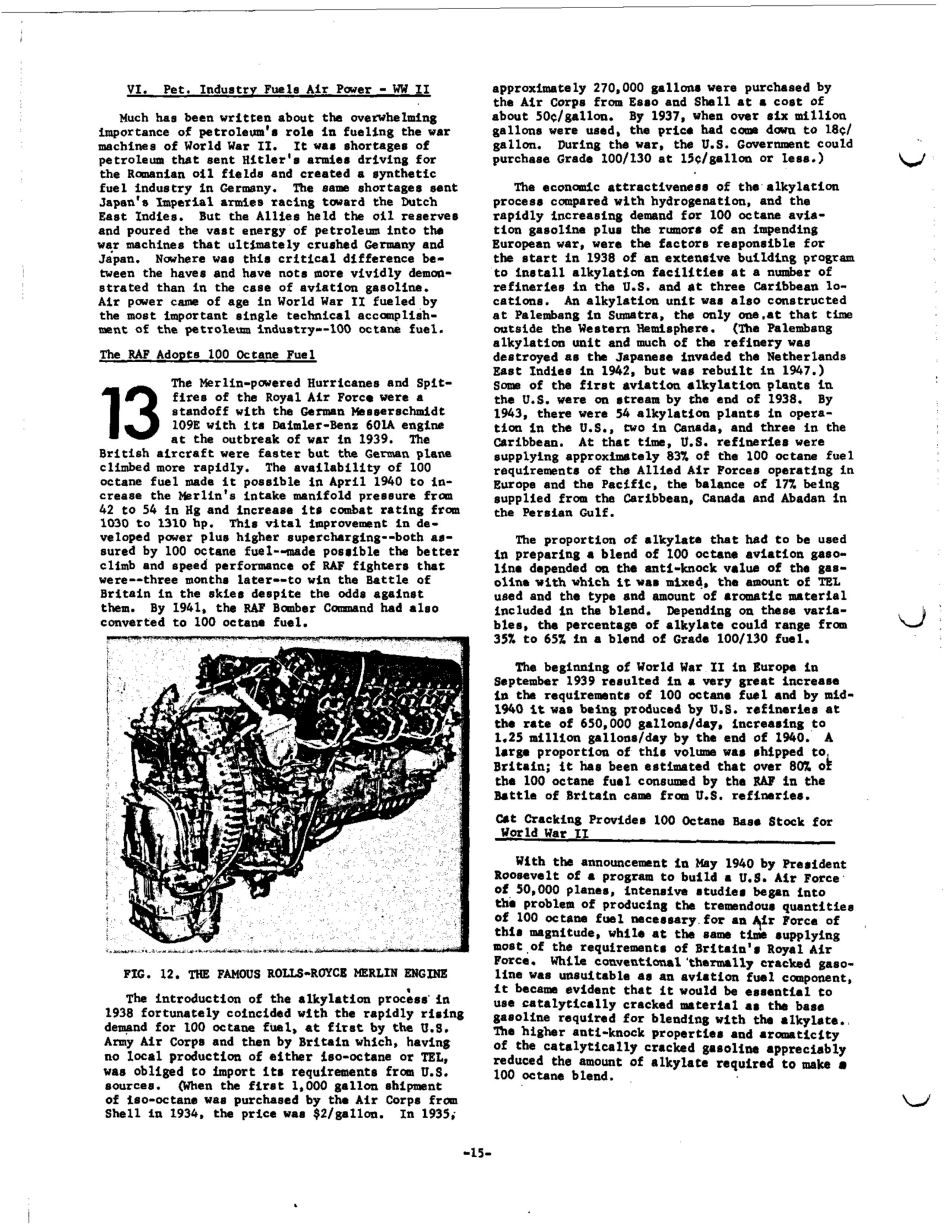 A. R. Ogston, excerpt from History of Aircraft Lubricants (Society of Automotive Enginees, Inc. Warrendale, PA USA), p. 12.  1)The authors of these articles are respected engineers and fuel technicians who are properly qualified to know how much power the Merlin III could generate on 100 octane fuel. 2)Rolls-Royce were already building Merlins that could run on 100 octane fuel in 1938. http://www.flightglobal.com/pdfarchi...0-%203453.html RM 2M "The normal output at 7,870ft. is 1,265 h.p. and the maximum at 9,500ft., 1,285 h.p. with 1,320 h.p. available for take-off....The maximum potential output of the Merlin II is 1,800 h.p..." 3) Not forgetting either that on August 7 1937 Rolls Royce had a "more-or-less standard Merlin II, running at 18 pounds boost on a special mixture of straight-run gasoline, benzol and methanol with a dash of tetraethyl lead, achieved an output of 1,536 hp at 2,850 rpm over a four minute run." (this was used for the Speed Spitfire). Price The Spitfire Story 2010 p. 107. Ergo the engine was already strong enough to take the extra power. Last edited by NZtyphoon; 03-09-2012 at 01:31 PM. |
|
#546
03-09-2012, 01:03 PM
|
|||
|
|||
|
Quote:
Except their is much proof that 100 octane was used. 
|
|
#547
03-09-2012, 01:14 PM
|
||||
|
||||
|
Mr Tomcat. Don't you think it a bit unfair that others need to provide 100% conclusive proof that their arguments are to be believed, yet all you need to provide is a 13 years after the event magazine article to be believed yourself?
It's not only unreasonable and arrogant, but also frustrating and insulting to those that spend their time on here trying to explain their findings to you. If you are not prepared to listen anyway, because to be honest that is the way it looks to the observer, then just say so now and save everybody the effort. You are being impolite, one would think somebody in the teaching profession would realise that. |
|
#548
03-09-2012, 01:59 PM
|
|||
|
|||
|
Quote:
Last edited by Bounder!; 03-09-2012 at 02:01 PM. |
|
#549
03-09-2012, 02:12 PM
|
|||
|
|||
|
Quote:
You'd need to really read it actually @Osp : for a bunch of guys tht are drawing disgusting parallel lines btw arguing abt the real use of that fuel with neo-nazi activism I think you shld drop out that virgin attitude. Does not fit. http://forum.1cpublishing.eu/showpos...&postcount=483 I am only interested by the truth. The only think I believed in is that RAF proved actually itself superior to the LW strategically and by employing better tactics. I am not harri potter, I don't believe in charms and incantatory self convincing sentences. |
|
#550
03-09-2012, 02:35 PM
|
|||
|
|||
|
I'm amazed at the resistance to 100 octane usage from some members on here.
The circumstancial evidence is overwhelming. I have loads of pilots memoirs from the BoB era and at lots of them mention putting 100 octane fuel in their cars, before, during and after the BoB. It doesn't sound like they were very carefull about saving 100 octane because it was in short supply. All RAF pilots who mention 100 octane say it was introduced just before the main battle, without exception. They have no reason to lie about this. They don't need to rewrite history, everyone knows what happened. There would be plenty of references to 'if we had 100 octane fuel we could have...' (much like all the references to cannons.. ie 'If we had cannons we would have..'). I have never seen a single reference made by an RAF pilot about the lack of 100 octane during the BoB. (I have at least 250 seperate accounts from the period.). Or how about a dated photograph? Whilst the conversion was taking place, as someone here has already mentioned, the ground crew painted '100' onto the cowling of the converted aircraft. Find me a photograph from June 1940 onwards where this marking is visable. I can't find one. The reason? Because the conversion process had finished and there was no need to differentiate between the 2 types of fuel. So like the others on here, I'd like to see a single account from somebody who was there that mentions a shortage/restriction re 100 oct during the battle. |
 |
|
|



 Linear Mode

