Fulqrum Publishing Home   |   Register   |   Today Posts   |   Members   |   UserCP   |   Calendar   |   Search   |   FAQ

Go Back   Official Fulqrum Publishing forum > Fulqrum Publishing > IL-2 Sturmovik: Cliffs of Dover > Technical threads > FM/DM threads

FM/DM threads Everything about FM/DM in CoD

Closed Thread
 
Thread Tools Display Modes
  #1  
Old 02-23-2012, 10:14 AM
NZtyphoon NZtyphoon is offline
Approved Member
 
Join Date: Feb 2012
Location: NZ
Posts: 543
Default

Okay, how about some simple calculations?

Now, there is no doubt that 100 Octane fuel was available to Fighter Command before and during the Battle of Britain.

How Much? Woods and Dempster say 22,000 tons - which is too low.

http://www.ww2aircraft.net/forum/tec...b-16305-2.html

Mike Williams #26 scroll down to Table II Monthly Consumption of fuel & oil:

June - Aug 1940 = 10,000 tons consumed
Sept - = 14,000 tons consumed
Oct = 17,000 tons consumed


1 imperial gallon of 100 Octane = 7.1 pounds ("Oil" by D.J Peyton-Smith the official British war history on the oil and petroleum industry during WW2 page xvii "Note on Weights and Measures"):

1 ton of 100 octane = 2,240 lbs therefore 2,240 divided by 7.1 = 315.5 imp gal

Fuel Capacities:

Defiant I = 97 imp gal
Hurricane I = 90 imp gal
Spitfire I & II = 84 imp gal
TOTAL = 271 imp gal divide by 3 = average fighter fuel load = 90.3 imp gal (Defiant from memory, so feel free to correct me. Defiant II = 104 imp gal)

1 ton = 315.5 imp gal divided by 90.3 imp gal = 3.5 fuel loads (or sorties) per ton of 100 octane fuel. Assuming all aircraft emptied their tanks for each sortie, and assuming all aircraft shot down = 1 fuel load of 90.3 imp gal

NB: Not all aircraft returned with empty tanks and RAF policy was to refill each aircraft as soon as possible after landing, or each evening or early morning, to avoid vapour traps.

Blenheims were the only other aircraft known to have used 100 Octane fuel, albeit only in their outer wing fuel tanks, making things complicated for the poor pilots. (Warner, The Bristol Blenheim:A Complete History 2nd ed, page 100.)

Merlin III & XIIs could still use 87 octane fuel, hence training flights and other secondary flight duties, such as delivery, ferry flights, etc could use 87 octane fuel instead of 100.

June to August: 10,000 tons x 3.5 = 35,000 fuel loads
September: 14,000 tons x 3.5 = 49,000 fuel loads
October: 17,000 tons x 3.5 = 59,500 fuel loads


June to October = 41,000 tons x 3.5 = 143,500 fuel loads in 22 weeks = 6,523 fuel loads = 931.8 fuel loads per day

If Woods and Dempster 22,000 tons distributed (not consumed) between July and September = 77,000 fuel loads divided by 13 weeks = 5,923 fuel loads per week = 846 fuel loads daily.

The Battle of Britain by T.C.G. James shows 51,364 sorties, day & night from July 10 through Sept 30; some of the most intensive combat took place between these dates. Of course there were quiet periods when far fewer combat sorties were flown by Fighter Command; eg: August 16 & 17, between two days of intensive combat August 15 & 18.

51,364 divided by 13 weeks = 4,280 fuel loads = 611 fuel loads daily
average:

Hooton’s Eagle in Flames, Table 2, FC flew Sep 23-29: 4,825 defensive sorties Sep 30 – Oct 6: 1,782 defensive sorties, and yet consumption of 100 Octane was still increasing.

Been here before, unfortunately http://www.ww2aircraft.net/forum/avi...a-20108-7.html

Last edited by NZtyphoon; 02-23-2012 at 10:15 AM. Reason: tweak
  #2  
Old 02-23-2012, 01:18 PM
TomcatViP TomcatViP is offline
Approved Member
 
Join Date: Aug 2010
Posts: 1,323
Default

Quote:
Originally Posted by NZtyphoon View Post

Now, there is no doubt that 100 Octane fuel was available to Fighter Command before and during the Battle of Britain.
really ?

20000 post of the same "piece of evidence" does not makes it a demonstrated fact. We are still waiting for some cross references.
  #3  
Old 02-23-2012, 01:40 PM
41Sqn_Banks 41Sqn_Banks is offline
Approved Member
 
Join Date: Oct 2007
Posts: 644
Default

Quote:
Originally Posted by TomcatViP View Post
really ?

20000 post of the same "piece of evidence" does not makes it a demonstrated fact. We are still waiting for some cross references.
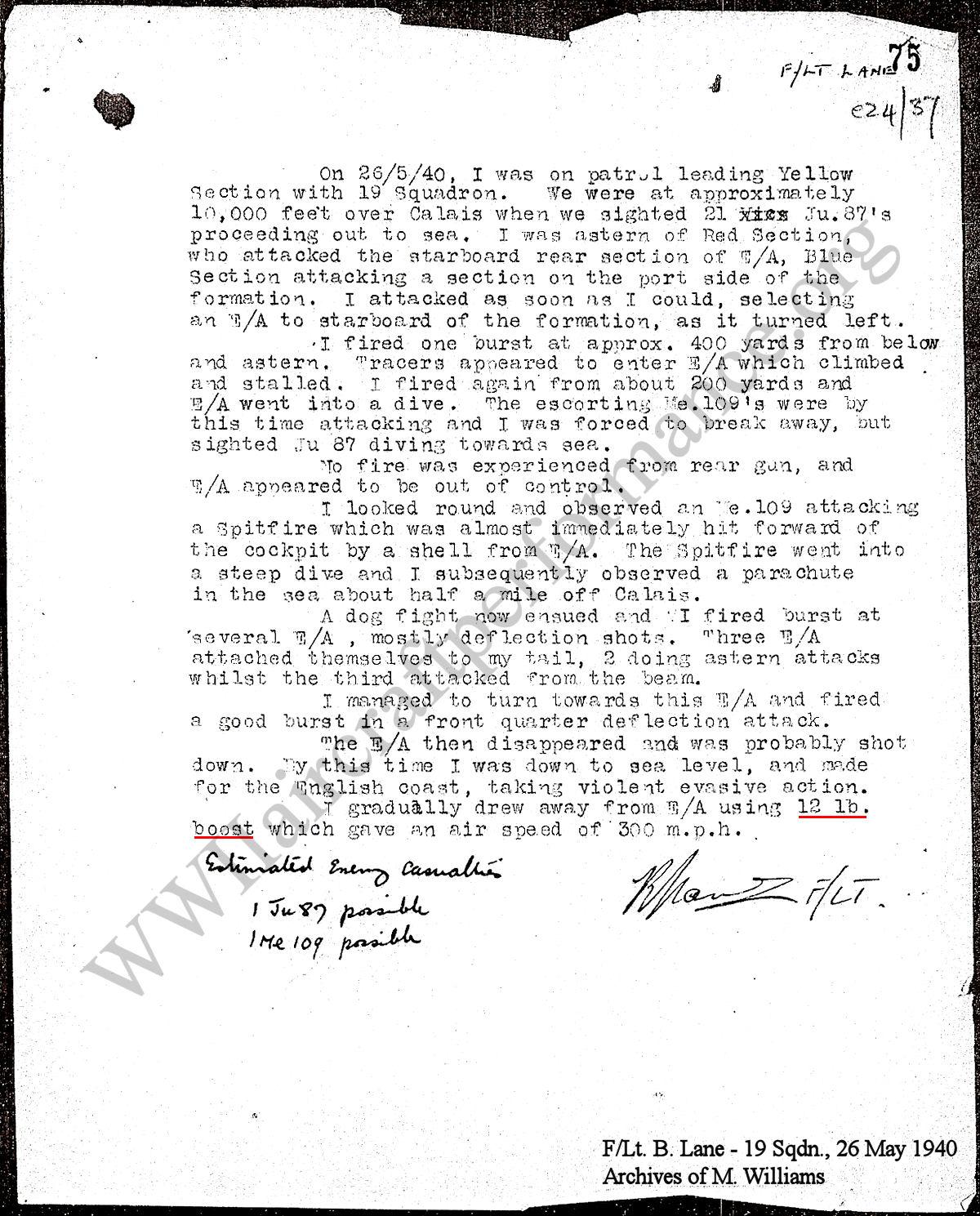
One combat report that shows the use of +12 boost (which requires 100 octane) is enough to proof that 100 octane was available. Of course it doesn't proof that it is available to all units, that's why NZtyphoon did the calculation.
  #4  
Old 02-23-2012, 01:59 PM
lane lane is offline
Approved Member
 
Join Date: Nov 2008
Posts: 141
Default

Quote:
Originally Posted by 41Sqn_Banks View Post
One combat report that shows the use of +12 boost (which requires 100 octane) is enough to proof that 100 octane was available.
Here's one!


  #5  
Old 02-23-2012, 02:20 PM
lane lane is offline
Approved Member
 
Join Date: Nov 2008
Posts: 141
Default

Quote:
June - Aug 1940 = 10,000 tons consumed
Sept - = 14,000 tons consumed
Oct = 17,000 tons consumed
Hi NZtyphoon:

Please note that the 10,000 tons of 100 octane, shown in Table II - Consumption consumed for the period June - Aug 1940, is the monthly average of those 3 months, therefore for the period June - Aug 1940 30,000 tons were actually consumed.
  #6  
Old 02-23-2012, 02:35 PM
VO101_Tom's Avatar
VO101_Tom VO101_Tom is offline
Approved Member
 
Join Date: Jul 2010
Location: Budapest, Hungary
Posts: 799
Default

Quote:
Originally Posted by lane View Post
IIRC no one contested this (availabe or not), only the quantity.
Interesting report. When he used the 12 lbs boost on deck, he was able to fly with only 300 mph...
__________________
| AFBs of CloD 2[/URL] |www.pumaszallas.hu

i7 7700K 4.8GHz, 32GB Ram 3GHz, MSI GTX 1070 8GB, 27' 1920x1080, W10/64, TrackIR 4Pro, G940
Cliffs of Dover Bugtracker site: share and vote issues here
  #7  
Old 02-23-2012, 07:15 PM
Kurfürst Kurfürst is offline
Approved Member
 
Join Date: Oct 2007
Posts: 705
Default

Quote:
Originally Posted by VO101_Tom View Post
IIRC no one contested this (availabe or not), only the quantity.
Indeed. I don't think anybody has doubts that 100 octane was used in a number of FC's - and also BC's Squadrons., as a number of Blenheim Squadrons (3 or 4 I believe), were also issued with the fuel. Which is why NYTyphoons 'calculations' are flawed and be considered at best for their entertainment value, as he ignores all bombers with many times the consumption and requirement of a fighter squadron, as well as training, moving flights and engine manufacturer demands, which are are simply ignored.

But the evidence to somewhat sensational claim that 100 octane was the only fuel issued is still sorely lacking and is directly contradicted by a number of primary and secondary sources. As another poster said, its a bit boring to see the same piece of non-evidence posted the 20000th time, it only seems to reinforce the sense that some people are perhaps a bit fanatical about enforcing their views on the others.

The trend shown in the consumption of 87 octane and 100 octane fuel is, however intererting. It is clear that about 2/3s of the fuel consumed during the Battle was 87 octane (by all Commands) and 1/3 consumed was 100 octane (by Fighter and Bomber Commands).

Checking the trend lines of operational (combat) Fighter sorties and 87 octane consumption during the Battle is interesting. When Fighter Command flew a lot of sorties, 87 octane issues also increased, when Fighter Command flew less of sorties, 87 octane demands decreased, with some delay of course. I think the conclusion is quite obvious.

Another interesting trend is that 87 octane issues suddenly plummeted during early october, while 100 octane issues increased. This is in line with Pips summary of the Australian paper, which notes that Fighter Command only switched completely over to 100 octane in the late automn 1940.

Its also completely in line with what an unquestionably reputable secondary source, Morgan nad Shacklady's ultimate Spitfire book, 'Spitfire: The History' notes about the initial uncertainity of 100 octane shipments (as all 100 octane had to be imported from overseas).

It also refers to the fact that RAF was intending to initially equip 16 fighter Squadrons and 2 bomber Squadrons with 100 octane, which is again underlined by the memo of the Fuel Commitee's meeting, noting that the selected fighter Squadrons and Blenheim Squadrons have been converted, the memo of which was summarized in a 'doctored' textus on Mike William's site to further the site's agenda.

Also of interest that the RAF wished to build up a reserve of 800 000 tons for precaution, which couldn't be met in 1940.
Attached Images
File Type: jpg 100-87issues-FC_sorties_duringBoB.jpg (17.9 KB, 78 views)
File Type: jpg shacklady100octane_1.JPG (634.2 KB, 8 views)
File Type: jpg shacklady100octane_2.jpg (669.6 KB, 9 views)
__________________
Il-2Bugtracker: Feature #200: Missing 100 octane subtypes of Bf 109E and Bf 110C http://www.il2bugtracker.com/issues/200
Il-2Bugtracker: Bug #415: Spitfire Mk I, Ia, and Mk II: Stability and Control http://www.il2bugtracker.com/issues/415

Kurfürst - Your resource site on Bf 109 performance! http://kurfurst.org

  #8  
Old 02-23-2012, 07:23 PM
Osprey's Avatar
Osprey Osprey is offline
Approved Member
 
Join Date: Jan 2010
Location: Gloucestershire, England
Posts: 1,264
Default

What exactly would make you happy Kurfurst?
  #9  
Old 02-23-2012, 07:55 PM
Al Schlageter Al Schlageter is offline
Approved Member
 
Join Date: Oct 2007
Posts: 657
Default

Quote:
This is in line with Pips summary of the Australian paper, which notes that Fighter Command only switched completely over to 100 octane in the late automn 1940.
LOL, this mysterious paper that only one person has ever seen.

So tell me Barbi, which fighter squadrons that were based on airfields on the CloD map were only using 87 octane fuel.
  #10  
Old 02-23-2012, 10:23 PM
NZtyphoon NZtyphoon is offline
Approved Member
 
Join Date: Feb 2012
Location: NZ
Posts: 543
Default

Quote:
Originally Posted by Kurfürst View Post
Indeed. I don't think anybody has doubts that 100 octane was used in a number of FC's - and also BC's Squadrons., as a number of Blenheim Squadrons (3 or 4 I believe), were also issued with the fuel. Which is why NYTyphoons 'calculations' are flawed and be considered at best for their entertainment value, as he ignores all bombers with many times the consumption and requirement of a fighter squadron, as well as training, moving flights and engine manufacturer demands, which are are simply ignored.
Note what I said:
NB: Not all aircraft returned with empty tanks and RAF policy was to refill each aircraft as soon as possible after landing, or each evening or early morning, to avoid vapour traps.

Blenheims were the only other aircraft known to have used 100 Octane fuel, albeit only in their outer wing fuel tanks, making things complicated for the poor pilots. (Warner, The Bristol Blenheim:A Complete History 2nd ed, page 100.)

Merlin III & XIIs could still use 87 octane fuel, hence training flights and other secondary flight duties, such as delivery, ferry flights, etc could use 87 octane fuel instead of 100.


Other aircraft known to have been using 100 Octane fuel were a small number of Beaufighters and PR Spitfires.

Westland Whirlwinds still used, and continued to use 87 Octane right through their operational lives.

Quote:
Originally Posted by Kurfürst View Post
But the evidence to somewhat sensational claim that 100 octane was the only fuel issued is still sorely lacking and is directly contradicted by a number of primary and secondary sources....
Nor did I say anywhere only 100 Octane fuel was issued. And where are KF's primary and secondary sources? The main primary sources "presented" by KF are a mysterious Australian/Beaverbrook paper which no-one apart from KF and "Pip" can find (The Australian National Archives themselves cannot find it), and some pre-war planning papers.

Quote:
Originally Posted by Kurfürst View Post
The trend shown in the consumption of 87 octane and 100 octane fuel is, however intererting. It is clear that about 2/3s of the fuel consumed during the Battle was 87 octane (by all Commands) and 1/3 consumed was 100 octane (by Fighter and Bomber Commands).
All KF is saying is that large numbers of aircraft in other commands were using 87 Octane. Big deal.

Quote:
Originally Posted by Kurfürst View Post
Checking the trend lines of operational (combat) Fighter sorties and 87 octane consumption during the Battle is interesting. When Fighter Command flew a lot of sorties, 87 octane issues also increased, when Fighter Command flew less of sorties, 87 octane demands decreased, with some delay of course. I think the conclusion is quite obvious.
Yup, there were things like training flights, delivery flights, ferry flights and other second-line duties which naturally increased at times when the frontline units were operating more intensively.

Quote:
Originally Posted by Kurfürst View Post
Another interesting trend is that 87 octane issues suddenly plummeted during early october, while 100 octane issues increased. This is in line with Pips summary of the Australian paper, which notes that Fighter Command only switched completely over to 100 octane in the late automn 1940.
Meaning FC switched to 100 Octane fuel for secondary as well as frontline duties? Seeing as no-one else apart from KF and "Pip" has seen this paper, and it is missing from the Australian National Archives I guess we have to take his word for it...

Quote:
Originally Posted by Kurfürst View Post
Its also completely in line with what an unquestionably reputable secondary source, Morgan nad Shacklady's ultimate Spitfire book, 'Spitfire: The History' notes about the initial uncertainity of 100 octane shipments (as all 100 octane had to be imported from overseas).
Convoys started operating in September 1939; the most important were the HX convoys which sailed from Halifax to (mainly) Liverpool. The first - HX.1 - sailed on 16 September 1939. Referring to http://www.convoyweb.org.uk/hague/index.html
The HX convoys incorporated cargo ships, some of which carried aviation fuel, and tankers: many of the latter had sailed from refineries in the West Indies and America. The BHX series sailed from Bermuda, starting in May 1940 (BHX.41), and joined the main HX convoys in Halifax. Some of the tankers from the HX convoys diverted to French ports, enough to supply the RAF fighters in France.

From the HX series of convoys alone (HX 11, 13, 31, 33-35, 40, 43, 49, 55, 57-59, 64-68, 70, 73, 76) 44 tankers carrying AVGAS arrived in British or French ports; one tanker was destroyed by a mine in the Bristol channel. This contradicts the assertion in Shacklady and Morgan that ...large numbers of tankers were sunk by German submarines...

Another reputable secondary source is "Oil" by Payton-Smith which, as noted, is the official war history. He notes that "...in the summer of 1940 there was a surplus of these ships (tankers) because of the incorporation into the British merchant marine of tanker fleets from countries over-run by Germany." pp. 128–130.

Quote:
Originally Posted by Kurfürst View Post
It also refers to the fact that RAF was intending to initially equip 16 fighter Squadrons and 2 bomber Squadrons with 100 octane, which is again underlined by the memo of the Fuel Commitee's meeting, noting that the selected fighter Squadrons and Blenheim Squadrons have been converted, the memo of which was summarized in a 'doctored' textus on Mike William's site to further the site's agenda.
This memo was a planning paper from 16 March 1939 , based on a pre-war assumption that US supplies would be denied to Britain in wartime, limiting the numbers of front-line units able to use the fuel.

In "Oil" (Official Second WW history) Payton-Smith said:

"By 1939...The prospects of securing sufficient supplies of 100-octane fuel in addition to the 87-octane petrol required for non-operational flying looked doubtful...(he goes on to state on page 57)...It was true that by 1939 it seemed increasingly unlikely that American supplies would be withheld. But to have accepted anything less than absolute certainty, to have depended on the goodwill of foreign suppliers to meet the essential needs of the Royal Air Force, would have been a radical break with traditions that had governed British oil policy since long before the First World War."

Meaning that the pre-war planning papers quoted by KF were being conservative in their estimates, as per a long held tradition.
Payton-Smith went on to say:

"...this problem (supply of 100 Octane aviation fuel) disappeared; production of the new fuel in the US, and in other parts of the world, increased more quickly than expected with the adoption of new refining techniques." pp. 259-260

Interesting how KF resorts to pre-war planning documents to say what happened up to 16 months later, during the Battle of Britain, yet cannot provide primary documentation to prove that the situations discussed up to two years earlier actually eventuated in 1940. And his assertions about "doctored" documents when his own documentation is so shoddy and questionable?

Quote:
Originally Posted by Kurfürst View Post
Also of interest that the RAF wished to build up a reserve of 800 000 tons for precaution, which couldn't be met in 1940.
Proving nothing really, except that in wartime pre-war plans can change. There was still more than enough 100 Octane fuel consumed by FC, and some Blenheims during the Battle to allow all operational sorties to be flown on this fuel alone.

Interesting to note that Merlin engines using 100 Octane fuel were being built in 1938, as well as C.P propellers

http://www.flightglobal.com/pdfarchi...0-%203453.html

Last edited by NZtyphoon; 02-23-2012 at 10:29 PM. Reason: Minor grammatical changes
Closed Thread


Posting Rules
You may not post new threads
You may not post replies
You may not post attachments
You may not edit your posts

BB code is On
Smilies are On
[IMG] code is On
HTML code is Off

Forum Jump


All times are GMT. The time now is 08:38 PM.


Powered by vBulletin® Version 3.8.4
Copyright ©2000 - 2025, Jelsoft Enterprises Ltd.
Copyright © 2007 Fulqrum Publishing. All rights reserved.