
|
|
#61
 11-06-2011, 06:26 PM
|
|||
|
|||

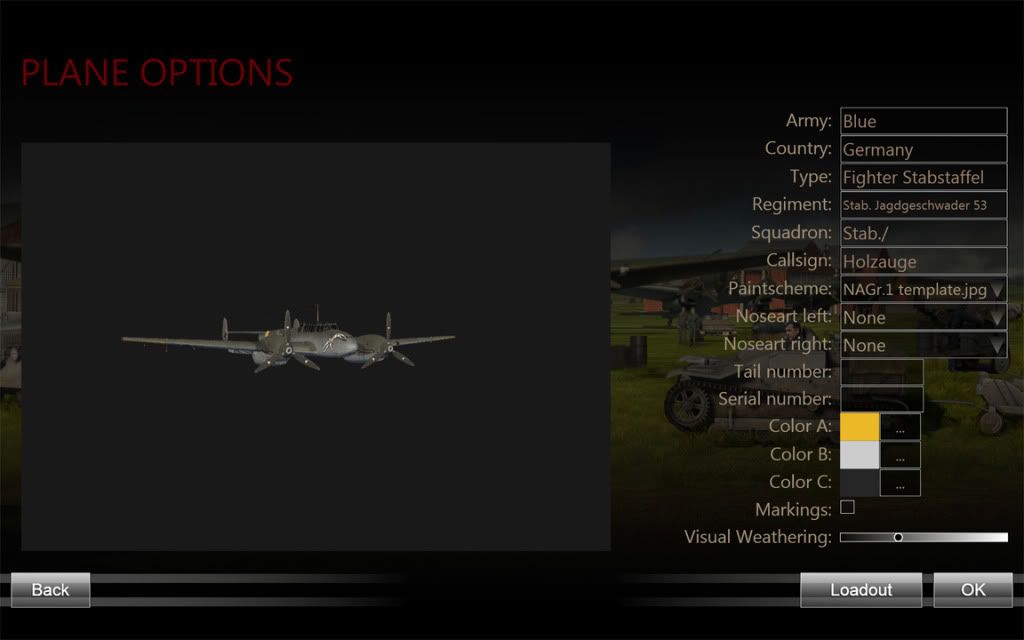 Although changes to the spinners are not previewed in Plane Options, they should be displayed when the plane is flown. I am at a loss to understand why they don't, especially if you've chosen the correct Paint Scheme. 
|
|
#62
11-07-2011, 04:09 PM
|
|||
|
|||
|
Hi aelius,
so it seems thats not only me with this problem. The funny thing is, that some Graf 110 skins showing this problem too, others dont. I know last time when used those skins they were functioning. Maybe it has something to do with the new patch. Nevermind, thank you for looking at this problem. Cheers LC QUOTE: Plt Off JRB Meaker Plt Off JRB Meaker Default New spinner colours for the Dorniers? I noticed recently that the spinner colours had been correcected on the Ju88 as of the last patches,I do hope they can correcect the Dornier spinners too. They are all in green,whereas historically they were yellow,red and white all it needs is the default Dornier skin to have three other alternatives. I know there are far more important errors to correct at the moment with COD but it would be nice at some stage. I'd do it myself but I don't have a template,if anyone can get one please let me know,I'm kinda desparate for one
__________________
MSI 790FX-GD70 Win 7 64bit AMD Phenom II 965BE 4 x 3.5Ghz ASUS GTX 680 TOP Corsair 16GB RAM Thrustmaster Warthog Hotas Saitek Pro Rudder Track IR 5 SB Audigy 2 ZS Last edited by LcSummers; 11-07-2011 at 04:23 PM.
|
|
#63
12-02-2011, 04:20 PM
|
|||
|
|||
   This Ju-87B-2 Trop belonged to 6./St.G 2 and was stationed on the Libyan coast at Tmimi, from where it provided ground support and attacked Allied shipping in the Mediterranean during the second half of 1941. The upper surface is RLM 79 (which I've softly mottled in RLM 80) and the undercarriage in RLM 78. What is remarkable, of course, is the extraordinary image down the entire length of the port side, which is reminiscent of Richthofen's Flying Circus and must have made the standard desert camouflage pattern completely irrelevant. The sinuous snake is based on an illustration by Rikyu Watanabe in Stuke Ju-87 by Alex Vanags-Baginskis. Although the aircraft identification letter (T6+MP) has been retained for these screenshots, it seems to have no historical justification. A similar plane (T6+CP)—or even the same plane, if the identification of one or the other is incorrect (one sheet of decals conveniently provides both letters)—is illustrated in Leonard and Jouineau's Junker's Ju-87 from 1936 to 1945 and John Weal's Junkers Ju 97 in North Africa and the Mediterranean, both of whom identify it as an extended range R-2 (Reichweite). This sub-variant had internal fuel tanks in the wings and two drop tanks in place of the bomb racks, which doubled or even tripled the range of the plane but limited it to a single 250 kg bomb. Apart from the increased amount of fuel and the absence of sirens on the wheel struts, the R-2 shared the same airframe as the B-2. The plane is thought to have been flown by Leutnant Hubert Pölz, who participated in the sinking of HMS Auckland off Tobruk in June 1941 and later was awarded the Knight's Cross and Oak Leaves on the Eastern Front, having flown over a thousand sorties to survive the war as a Gruppenkommandeur. Thanks to VO101 Tom for his panel finder, without which I still would be trying to align the Mediterranean theater band, and especially to Shado for making the Ju-87 accessible in the first place. Last edited by aelius; 12-06-2011 at 06:34 PM.
|
|
#64
12-02-2011, 04:24 PM
|
||||
|
||||
|
Now that is sweet
__________________
Regards Chris  http://www.aircombatgroup.co.uk/index.php Gigabyte z77-d3h, Intel Core i5-3570K 3.40GHz (OC 4.2GHz), Corsair Vengeance Low Profile 24GB DDR3 PC3-12800C9 1600MHz Dual Channel Kit , Samsung 120GB SSD 840 SATA 6Gb/s Basic, Seagate Barracuda 7200RPM 1TB SATA 6Gb/s 64MB, Cooling Silencer Mk II 750W '80 Plus Silver' PSU, GTX580 3gb OC
|
|
#65
12-03-2011, 11:46 AM
|
|||
|
|||
|
WOW thats a master art!
Looking awesome. Great work and welcome back old painter  LOOKING FORWARD!!!!!!!!
__________________
MSI 790FX-GD70 Win 7 64bit AMD Phenom II 965BE 4 x 3.5Ghz ASUS GTX 680 TOP Corsair 16GB RAM Thrustmaster Warthog Hotas Saitek Pro Rudder Track IR 5 SB Audigy 2 ZS
|
|
#66
12-03-2011, 05:59 PM
|
||||
|
||||
|
Just fantastic.. wish we were getting the Med next to put this in!
|
|
#67
12-04-2011, 09:56 AM
|
|||
|
|||
|
Wow - that Stuka is unbelievable!
Very very nice work!
|
|
#69
12-08-2011, 04:14 PM
|
||||
|
||||
|
Boy oh boy! I first found a picture of this Stuka back in 1962 in a long out of print ( 1944) book covering the war..I even did a colored pecil rendering of the same...so it is one of my favorites.several versions have been available in Il-2 for bothe the Ju-87B & later versions , but unfortunately no one has ever takenthe time to really go over the exterior of the IL-2 birds to get them up to the standard of say the Il-2 third party redo's of the Bf-109s & FW-190s .No such problem here at CloD where the Stuka really is sharp! Now with this skin its even better & if all goes well we'll have a Med map to use it on in what 4 or 5 years? Til then it ,when available, it will appear over the Channel! can't wait o get it to download!!!!!!
|
|
#70
12-08-2011, 05:12 PM
|
|||
|
|||
  Snakes on a plane! Two more screenshots, this time derived from the color profile of T6+CP in Weal, and Leonard and Jouineau. Although not as personally satisfying as the interpretation by Watanabe, the snake profiled by these later authors is much better known. The unit code is T6+CP but, like the T6+MP illustrated by Watanabe, it is informed supposition, based on a photograph that had shown only the front of the plane forward of the cockpit. Not until 2005 were more complete photographs published that allowed a correct profile of the Schlange Sturzkampfflugzeug. And it is that plane, T6+DP, on which I am working.
|
 |
|
|


 That is absoloutly gorgeous!
 Linear Mode

