
|
|
#211
 06-21-2011, 01:37 PM
|
|||
|
|||

I will do this justice tomorrow but in the meantime
a) are you confirming that what PIP posted is your belief as to what happened b) where you say I admitted that this was not revised, can you point me to the posting. re (b) I am not doubting you, I just want to avoid a misunderstanding as a lot has been said. Speak to you tomorrow |
|
#212
06-21-2011, 01:49 PM
|
|||
|
|||
|
Quote:
Quote:
In all the documentation Neil and you publicly provided, there's a huge gap between May and August 1940. And let's be frank about it, both of you are fanatic about the subject, and that's exactly the timeframe Pips was talking about YEARS before you found that paper. That's some food for thought isn't it. I am pretty sure of two things: that you weren't running out of battery in your camera when you got there, and if it would revise the 18 May paper in a way positive to you and say that all Sqns gonna use 100 octane, it would be posted all over the place. See ya tomorrow. 
__________________
Il-2Bugtracker: Feature #200: Missing 100 octane subtypes of Bf 109E and Bf 110C http://www.il2bugtracker.com/issues/200 Il-2Bugtracker: Bug #415: Spitfire Mk I, Ia, and Mk II: Stability and Control http://www.il2bugtracker.com/issues/415 Kurfürst - Your resource site on Bf 109 performance! http://kurfurst.org 
|
|
#214
06-21-2011, 04:17 PM
|
|||
|
|||
|
Quote:
The linkage is inescapable and provides solid proof. The RAF was systematically supplying ALL Stations which had Merlin equipped aircraft with 100 octane fuel. The 2nd memo indicates the process was ongoing. Church Fenton, Grangemouth and Filton are expected to be hosting Merlin equipped Squadrons in the near future, so they are added to the list of Stations requiring 100 octane. This follows naturally with the conversion of RAF Fighter Squadrons from Gladiators/Gauntlets etc. to Hurricanes/Spitfires/Defiants during 1939 and early 1940. Gladiators/Gauntlets and all the obsolete types use 87 octane, of fighters, only Merlin equipped Spitfires/Hurricanes/Defiants use 100 octane. Note also the stations requiring the fuel are "operational" stations, the stations not requiring the fuel are "nonoperational". Clearly the stations being supplied are central to the RAF's Tactical plan. Only Stations which are hosting Squadrons which have been declared operational are supplied, ie. only stations whose aircraft have been released to conduct interceptions, attacks etc. Ie. the fighting force of the RAF is stationed at fields with 100 octane. Squadrons which have not been released for combat are based at fields with no 100 octane supply. Again, the logic is inescapable, the RAF is preparing to fight with aircraft based at stations supplied with 100 octane fuel. Let us also remember, stations supplied with 100 octane DO NOT retain enough supply of 87 octane to fuel Squadrons based there who use that fuel type, only enough 87 octane is retained to supply the occasional aircraft which is forced to land due to mechanical or combat issues. Last edited by *Buzzsaw*; 06-21-2011 at 04:42 PM. |
|
#215
06-21-2011, 04:36 PM
|
||||
|
||||
|
I like how you guys present letters that talk about planning to supply these stations with fuel as concrete evidence that they were supplied.
|
|
#216
06-21-2011, 04:58 PM
|
|||
|
|||
|
Quote:
Contrast with the Luftwhiner side, which has yet to provide a single document indicating any RAF fighter Squadron used 87 octane during the battle. But of course, that's not surprising, that is the double standard the luftwhiners insist on. |
|
#217
06-21-2011, 05:27 PM
|
||||
|
||||
|
Your bias for the red side was established long long ago, Buzzsaw.
|
|
#218
06-21-2011, 05:57 PM
|
|||
|
|||
|
Quote:
Quote:
Quote:
The only case where you would have mis-matched fuel types in a single flight is if you diverted to another field using a different octane rating and then taking part in a scramble before going back to your own base. Even so, maintaining formation is not done on full throttle anyway, so the point is moot. A flight leader will always fly slightly lower power settings than the nominal values for a very simple reason: if you're the first to take-off and start climbing (aka getting into a region of a higher TAS as you go along) it's increasingly harder for the wingmen to keep up with you if you are already running the maximum values. Another reason is fuel economy, yet another one is that the faster you go the more pronounced any mistake is in station keeping. Have you ever flown formation to the AI in IL2:1946 with their magic, non-overheating engines? If you did then you know what i'm talking about. Since the amount of boost and RPM used is what governs produced HP, it's perfectly possible to keep formation even when using different octane rating fuel. The only case where a discrepancy would occur and aircraft would be spaced apart is when going to full power, because a difference in O.R. institutes a difference in what full power is for each aircraft. But then again, this happens in combat where (gasp!) it actually makes sense to loosen and even break up the formation, something the RAF realized early on after incidents where multiple losses were incurred because pilots were more busy keeping a close vic formation than actually splitting up and flying combat properly, so they switched their tactics. In short, a different O.R. has minimal effect in how you keep formation because formations are not flown at full power. You think too much in terms of pure numbers and totally sidestep tactical considerations and how a mission profile usually plays out. But then again, you're convinced it's possible to run engines on full WEP all day long, so i'm not surprised.  As for the Blenheim, yes it takes time until the residual fuel is burned up and there might even be a case of air in the lines when switching over from tank to tank, which is why it's standard procedure in many aircraft to turn on the fuel boost pumps whenever changing tanks and keep them running for a short while. Also, full fuel was not only loaded for ferry flights. It was specifically used for long range raids, like the one on the Cologne power station. I have the actual pilot's manual and the main reason they used 100 octane in the first place was because the aircraft was too heavy to safely get off the ground with a full fuel load without the extra boost. Last edited by Blackdog_kt; 06-21-2011 at 06:05 PM. |
|
#219
06-21-2011, 07:36 PM
|
|||
|
|||
|
Quote:
Quote:
It was common for pilots to land and refuel at the most convenient base, then return to base and fly another mission, so if 100 octane wasn't universally used then there is a high probability that fighter squadrons would be forced into combat with mixed 87 and 100 octane fuel loads, yet there is no historical account of this ever happening. Quote:
It was possible, and was done on multiengined Merlin aircraft, when one or more engines failed. 12lb boost is not an excessive boost level even for a Merlin III, and as long as the cooling and lubrication stay in the black, the probability of failure is low: 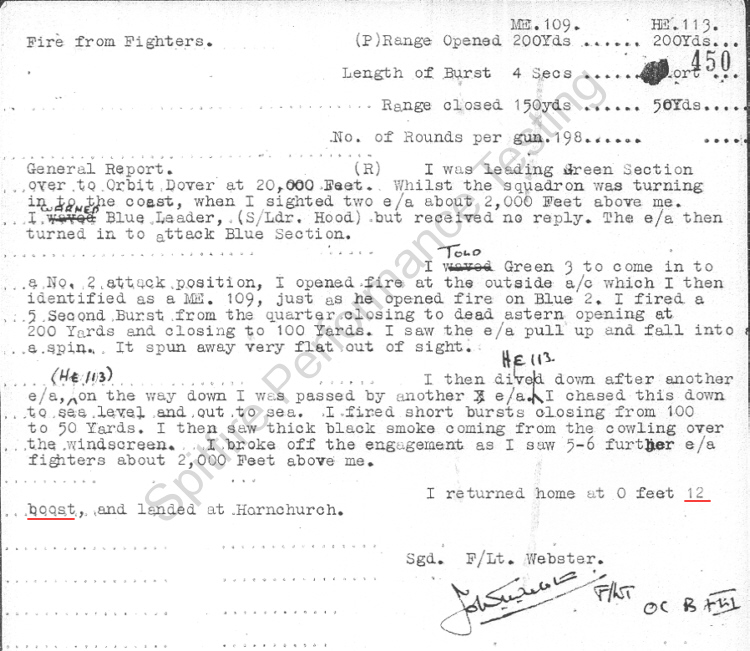 Dover Castle to Hornchurch is ~55 miles, or about 11 minutes at 300mph, and this pilot was further east than Dover Castle.. |
|
#220
06-21-2011, 09:40 PM
|
|||
|
|||
|
Quote:
As for the rest of your post, 11 minutes is a reasonable amount of time (even though exceeding the specified guidelines) and a far stretch from all day long WEP running. Let me ask you one question just to eliminate any suspicion of bias and restore my willingness to be convinced that your arguments are about what you perceive to be historically accurate and not about gameplay advantages: if someone finds combat reports stating similar situations for 109s, will you be content to let DB601s run WEP in a similar fashion (ie, with the only constraint being fuel expense)? |
 |
|
|



 Linear Mode

