
|
|
#311
 07-23-2011, 03:28 PM
|
|||
|
|||

Quote:
|
|
#312
07-24-2011, 11:51 PM
|
|||
|
|||
|
The only interesting thing that I picked up was that there was a serious shortage of 100 Octane Fuel, serious enough to start impacting operations in the period May to August 1944 (not 1940).
Emergency measures were taken such as switching RAF squadrons which had US radial engines to US 90 octane fuel and a temporary dip below the previously set strategic minimum reserve level. Once the invasion was firm and the pressure eased the situation returned to normal. There was one file I was after which they couldn't find and another that I had high hopes of, that only had one sheet of paper in it. Its unlikely that I will get to visit again until October. Kurfurst, How did you get on finding evidence of the May 1940 meetings that support Pips posting? |
|
#313
08-03-2011, 10:41 PM
|
|||
|
|||
|
Quote:
No 111 squadron (based at Drem) On the 15th February 1940 the squadron was released while the tanks were drained and replaced by 100 Octane. No 32 Squadron (based Gravesend) 29th February 1940, 20 new type aircraft fitted with Metal Wings, new propellers and fuel were delivered during the month. 13 L type machines were flown away No 213 Squadron 24th February new aircraft were delivered to the squadron. As you can see, no 111 and 32 squadrons are pretty clear, but I have little doubt that no 213 squadron will be debated by some. My personal view is that if 32 squadron received new aircraft with all the improvements, its unlikely that 213 wouldn't less than a week earlier. I did go to look up 232 squadron but they only formed in July 1940 when 100 Octane was the normal issue, so it wouldn't have been worth mentioning, i did look but there was no mention. I found it interesting that all the dates are in February. Last edited by Glider; 08-04-2011 at 09:33 PM. |
|
#314
02-23-2012, 10:14 AM
|
|||
|
|||
|
Okay, how about some simple calculations?
Now, there is no doubt that 100 Octane fuel was available to Fighter Command before and during the Battle of Britain. How Much? Woods and Dempster say 22,000 tons - which is too low. http://www.ww2aircraft.net/forum/tec...b-16305-2.html Mike Williams #26 scroll down to Table II Monthly Consumption of fuel & oil: June - Aug 1940 = 10,000 tons consumed Sept - = 14,000 tons consumed Oct = 17,000 tons consumed 1 imperial gallon of 100 Octane = 7.1 pounds ("Oil" by D.J Peyton-Smith the official British war history on the oil and petroleum industry during WW2 page xvii "Note on Weights and Measures"): 1 ton of 100 octane = 2,240 lbs therefore 2,240 divided by 7.1 = 315.5 imp gal Fuel Capacities: Defiant I = 97 imp gal Hurricane I = 90 imp gal Spitfire I & II = 84 imp gal TOTAL = 271 imp gal divide by 3 = average fighter fuel load = 90.3 imp gal (Defiant from memory, so feel free to correct me. Defiant II = 104 imp gal) 1 ton = 315.5 imp gal divided by 90.3 imp gal = 3.5 fuel loads (or sorties) per ton of 100 octane fuel. Assuming all aircraft emptied their tanks for each sortie, and assuming all aircraft shot down = 1 fuel load of 90.3 imp gal NB: Not all aircraft returned with empty tanks and RAF policy was to refill each aircraft as soon as possible after landing, or each evening or early morning, to avoid vapour traps. Blenheims were the only other aircraft known to have used 100 Octane fuel, albeit only in their outer wing fuel tanks, making things complicated for the poor pilots. (Warner, The Bristol Blenheim:A Complete History 2nd ed, page 100.) Merlin III & XIIs could still use 87 octane fuel, hence training flights and other secondary flight duties, such as delivery, ferry flights, etc could use 87 octane fuel instead of 100. June to August: 10,000 tons x 3.5 = 35,000 fuel loads September: 14,000 tons x 3.5 = 49,000 fuel loads October: 17,000 tons x 3.5 = 59,500 fuel loads June to October = 41,000 tons x 3.5 = 143,500 fuel loads in 22 weeks = 6,523 fuel loads = 931.8 fuel loads per day If Woods and Dempster 22,000 tons distributed (not consumed) between July and September = 77,000 fuel loads divided by 13 weeks = 5,923 fuel loads per week = 846 fuel loads daily. The Battle of Britain by T.C.G. James shows 51,364 sorties, day & night from July 10 through Sept 30; some of the most intensive combat took place between these dates. Of course there were quiet periods when far fewer combat sorties were flown by Fighter Command; eg: August 16 & 17, between two days of intensive combat August 15 & 18. 51,364 divided by 13 weeks = 4,280 fuel loads = 611 fuel loads daily average: Hooton’s Eagle in Flames, Table 2, FC flew Sep 23-29: 4,825 defensive sorties Sep 30 – Oct 6: 1,782 defensive sorties, and yet consumption of 100 Octane was still increasing. Been here before, unfortunately http://www.ww2aircraft.net/forum/avi...a-20108-7.html Last edited by NZtyphoon; 02-23-2012 at 10:15 AM. Reason: tweak |
|
#315
02-23-2012, 01:18 PM
|
|||
|
|||
|
Quote:
20000 post of the same "piece of evidence" does not makes it a demonstrated fact. We are still waiting for some cross references. |
|
#316
02-23-2012, 01:40 PM
|
|||
|
|||
|
Quote:
|
|
#318
02-23-2012, 02:20 PM
|
|||
|
|||
|
Quote:
Please note that the 10,000 tons of 100 octane, shown in Table II - Consumption consumed for the period June - Aug 1940, is the monthly average of those 3 months, therefore for the period June - Aug 1940 30,000 tons were actually consumed. |
|
#319
02-23-2012, 02:35 PM
|
||||
|
||||
|
Quote:
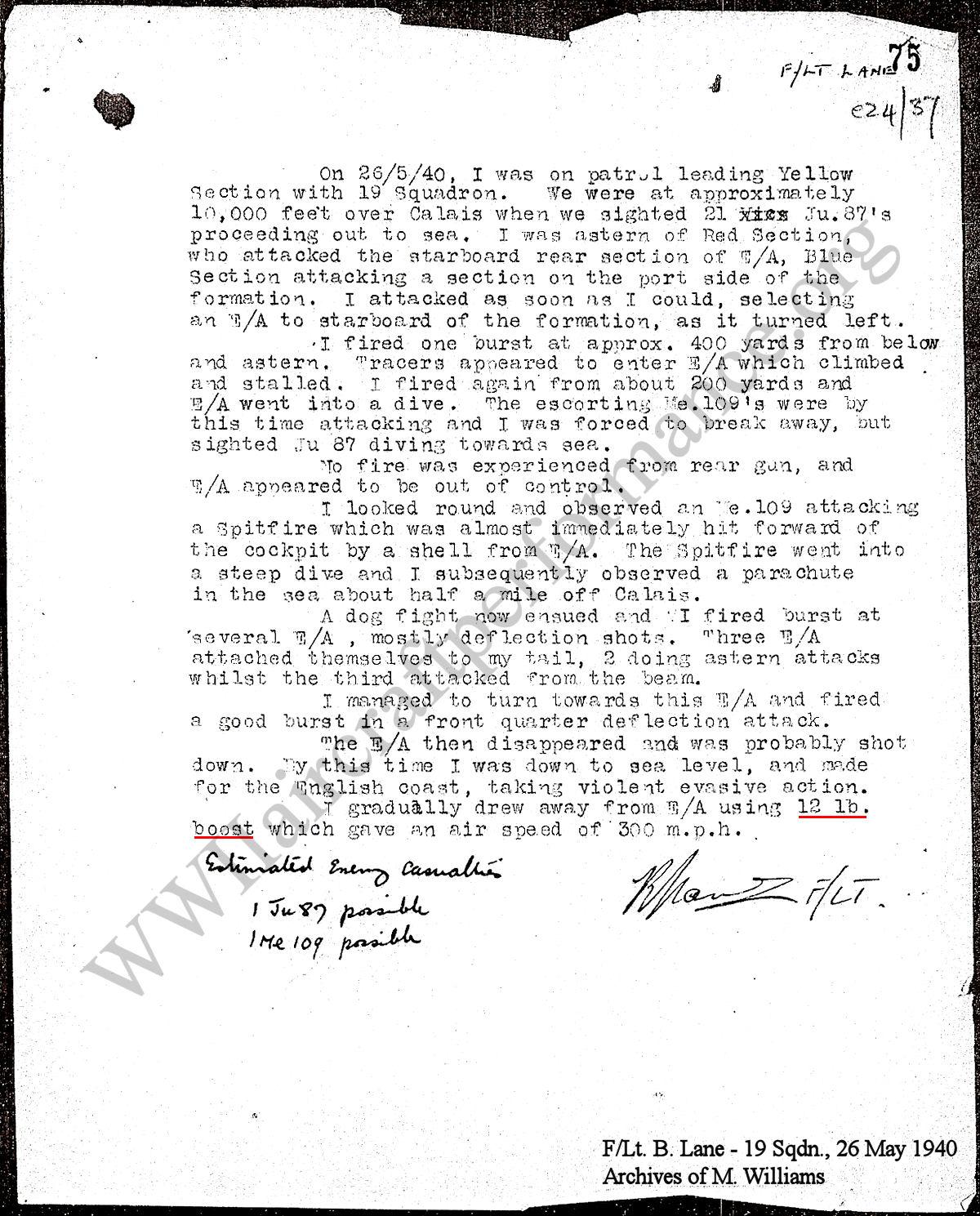
Interesting report. When he used the 12 lbs boost on deck, he was able to fly with only 300 mph...
__________________
 | AFBs of CloD 2[/URL] |www.pumaszallas.hu | AFBs of CloD 2[/URL] |www.pumaszallas.hu i7 7700K 4.8GHz, 32GB Ram 3GHz, MSI GTX 1070 8GB, 27' 1920x1080, W10/64, TrackIR 4Pro, G940 Cliffs of Dover Bugtracker site: share and vote issues here |
|
#320
02-23-2012, 07:15 PM
|
|||
|
|||
|
Quote:
But the evidence to somewhat sensational claim that 100 octane was the only fuel issued is still sorely lacking and is directly contradicted by a number of primary and secondary sources. As another poster said, its a bit boring to see the same piece of non-evidence posted the 20000th time, it only seems to reinforce the sense that some people are perhaps a bit fanatical about enforcing their views on the others. The trend shown in the consumption of 87 octane and 100 octane fuel is, however intererting. It is clear that about 2/3s of the fuel consumed during the Battle was 87 octane (by all Commands) and 1/3 consumed was 100 octane (by Fighter and Bomber Commands). Checking the trend lines of operational (combat) Fighter sorties and 87 octane consumption during the Battle is interesting. When Fighter Command flew a lot of sorties, 87 octane issues also increased, when Fighter Command flew less of sorties, 87 octane demands decreased, with some delay of course. I think the conclusion is quite obvious. Another interesting trend is that 87 octane issues suddenly plummeted during early october, while 100 octane issues increased. This is in line with Pips summary of the Australian paper, which notes that Fighter Command only switched completely over to 100 octane in the late automn 1940. Its also completely in line with what an unquestionably reputable secondary source, Morgan nad Shacklady's ultimate Spitfire book, 'Spitfire: The History' notes about the initial uncertainity of 100 octane shipments (as all 100 octane had to be imported from overseas). It also refers to the fact that RAF was intending to initially equip 16 fighter Squadrons and 2 bomber Squadrons with 100 octane, which is again underlined by the memo of the Fuel Commitee's meeting, noting that the selected fighter Squadrons and Blenheim Squadrons have been converted, the memo of which was summarized in a 'doctored' textus on Mike William's site to further the site's agenda. Also of interest that the RAF wished to build up a reserve of 800 000 tons for precaution, which couldn't be met in 1940.
__________________
Il-2Bugtracker: Feature #200: Missing 100 octane subtypes of Bf 109E and Bf 110C http://www.il2bugtracker.com/issues/200 Il-2Bugtracker: Bug #415: Spitfire Mk I, Ia, and Mk II: Stability and Control http://www.il2bugtracker.com/issues/415 Kurfürst - Your resource site on Bf 109 performance! http://kurfurst.org 
|
 |
| Thread Tools | |
| Display Modes | |
|
|






 Linear Mode

