Fulqrum Publishing Home   |   Register   |   Today Posts   |   Members   |   UserCP   |   Calendar   |   Search   |   FAQ

Go Back   Official Fulqrum Publishing forum > Fulqrum Publishing > IL-2 Sturmovik: Cliffs of Dover

IL-2 Sturmovik: Cliffs of Dover Latest instalment in the acclaimed IL-2 Sturmovik series from award-winning developer Maddox Games.

Reply
 
Thread Tools Display Modes
  #1  
Old 04-21-2012, 07:07 AM
41Sqn_Banks 41Sqn_Banks is offline
Approved Member
 
Join Date: Oct 2007
Posts: 644
Default

Hello Ivan, I strongly disagree.

Quote:
The division of Take off use and in flight use in the engine limitations section of the notes does not imo amount to much other than stipulating the desired 1 min take off limitation.


It's clear that they are two different mechanisms. Both increase the boost (and deactivate the boost control) but the "take-off" boost additionally uses "excessively rich mixture":


Quote:
As can be seen this indicates removal of the Boost Cutout catch allows further forward throttle movement to achieve up to +12Lbs boost.
The Spitfire I manual states that "and so open full throttle at the carburretor at any time". It's not speaking about the throttle lever but the throttle valve, which can't be opened at any time when the boost control is enabled.


Quote:
In combat the pilot might enter the fight with Boost Cutout switch already rotated forward ready to go, so he doesnt have think about finding and pushing the cutout switch forward in the heat of combat. Then he can easily get +12 by simply rocking the throttle past the gate and pushing it all the way forward. If not in dire straits then he knows pushing the throttle to the gate will give him rated +9lbs boost.
As soon as the switch is rotated the boost control is deactivated and and at low altitudes almost any throttle lever setting will give +12 boost.

Also looking at the throttle control drawings it don't see how the switch would prevent the throttle from moving to the most forward position or through the gate.

If both things were the same, how was it possible that in the updated Spitfre II manual take-off boost is given as +12.5 and emergency as +12?
Attached Images
File Type: jpg MerlinXX.jpg (231.7 KB, 20 views)

Last edited by 41Sqn_Banks; 04-21-2012 at 07:11 AM.
Reply With Quote
  #2  
Old 04-23-2012, 12:37 PM
NZtyphoon NZtyphoon is offline
Approved Member
 
Join Date: Feb 2012
Location: NZ
Posts: 543
Default

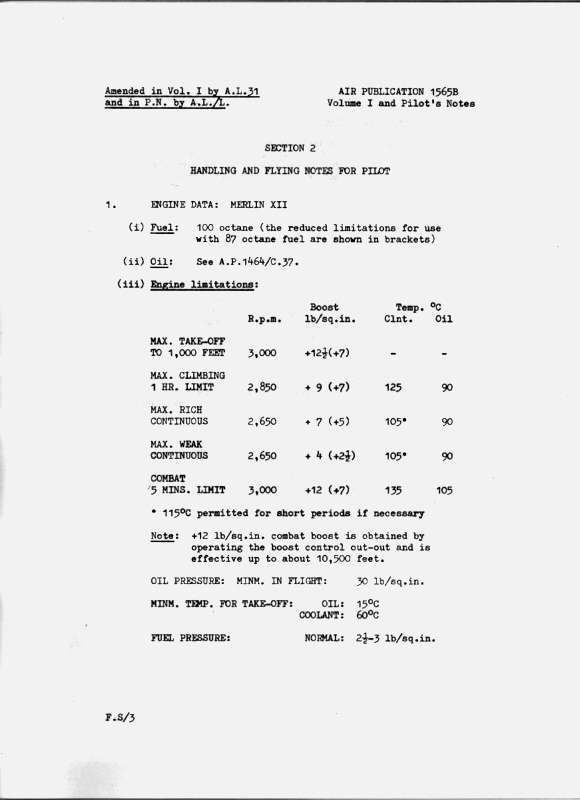
There could be a reason for the difference; read #1219. I know that there is a set of Spitfire II notes on Scribd; these show that there have been no amendments and it is possible that the operational limits for the Merlin XII were originally set at +9 lbs boost, later pushed to +12 1/2 lbs. (Paragraph 4 of the attached document does state that the Merlin XII was cleared for this boost.) It is possible that on operational units an amendment slip specifying +12 1/2 lbs was issued with the notes.

There is a small possibility of printer error, for example on p3 it describes the Spitfire II as being "powered by a Merlin III..."

Correction: This particular set of notes does incorporate some amendments, on top of page 6 and 19 "Amended by A.L.No.6" - interesting; this indicates they could have been republished later than July 1940.
Attached Images
File Type: jpg spit1-12lbs.jpg (286.8 KB, 16 views)

Last edited by NZtyphoon; 04-23-2012 at 12:50 PM. Reason: Correction...
Reply With Quote
  #3  
Old 04-23-2012, 12:46 PM
41Sqn_Banks 41Sqn_Banks is offline
Approved Member
 
Join Date: Oct 2007
Posts: 644
Default

Quote:
Originally Posted by NZtyphoon View Post
There could be a reason for the difference; read #1219. I know that there is a set of Spitfire II notes on Scribd; these show that there have been no amendments and it is possible that the operational limits for the Merlin XII were originally set at +9 lbs boost, later pushed to +12 1/2 lbs. (Paragraph 4 of the attached document does state that the Merlin XII was cleared for this boost.) It is possible that on operational units an amendment slip specifying +12 1/2 lbs was issued with the notes.

There is a small possibility of printer error, for example on p3 it describes the Spitfire II as being "powered by a Merlin III..."
Now that's a interesting find. The page without amendments only give +12 boost for take-off, but the 1939 documents states +12.5 boost for take-off.

However it's still clear from the June 1940 "List of content" that the page that contains the +12 emergency boost was not contained at that date and was added later and at that date only the page without +12 emergency boost was contained.

IMHO the easiest would be to get the combat reports of the "units concerned" (pun intended ) to find one that proofs the use of +12 in a Spitfire II or search in the National Archives for a similar doc like the one that clears the use of +12 emergency boost for Merlin XX.
Reply With Quote
  #4  
Old 04-24-2012, 09:34 AM
Talisman Talisman is offline
Approved Member
 
Join Date: Oct 2007
Location: United Kingdom
Posts: 74
Default

Quote:
Originally Posted by 41Sqn_Banks View Post
Now that's a interesting find. The page without amendments only give +12 boost for take-off, but the 1939 documents states +12.5 boost for take-off.

However it's still clear from the June 1940 "List of content" that the page that contains the +12 emergency boost was not contained at that date and was added later and at that date only the page without +12 emergency boost was contained.

IMHO the easiest would be to get the combat reports of the "units concerned" (pun intended ) to find one that proofs the use of +12 in a Spitfire II or search in the National Archives for a similar doc like the one that clears the use of +12 emergency boost for Merlin XX.
With regard to the pilot notes, RAF Air Publication (AP) amendments are well known for being behind the times as far as up-to-date common practise at the front line is concerned. It may be many months and over a year or so before an AP is fully updated to reflect what is actually taking place on the ground and in the air.

A fighting force does not wait for the AP to be updated before taking actions that are operationally required to provide an advantage in combat (AP amendments are not a priority when fighting a war). In the mean time, RAF personnel may be informed and corporate knowledge developed by other means of authorised advanced information contained in a variety of communication methods, such as signals, memos, letters, advanced information leaflets (destroyed once formal amendment leaflet is incorporated into the AP), briefings and local training.

The date an Amendment Leaflet is issued is not an indication of when the subject practise was first authorised or carried out. Moreover, the vast number of aircraft AP copies in existence would not have all been amended with updated changes on the same date; different copies of the same AP held across the RAF at squadron and flight level will have different dates recorded on the amendment leaflet record for the incorporation of the amendment. Also, it is not unusual for amendment leaflets to go missing in transit and for a unit to receive an amendment leaflet out of sequence, or for the AP to have a number of missing amendment leaflets; no system is perfect.

As for the pilot in the air in a life and death situation over his own territory, given a situation where extra boost is available, I do not believe that he is going to wait for authorisation to use extra boost if it enables him to win a fight, survive another day or save the life of another pilot or people on the ground. After all, pilots were known to ram enemy aircraft and such authorisation will not be found in AP pilot notes (tongue in cheek, LOL).
Reply With Quote
  #5  
Old 04-30-2012, 02:11 AM
irR4tiOn4L irR4tiOn4L is offline
Approved Member
 
Join Date: Feb 2011
Posts: 138
Default

Quote:
The top speed of this aeroplane is the same as that of N.3171 but is reached at 17,600 feet, 1400 feet lower than the Mk.I Spitfire. Consequent upon this and the increase in power of the Merlin XII over the Merlin III below full throttle height the aeroplane is about 6 - 7 miles per hour faster at heights less than 17,000 feet and about 4 - 8 m.p.h. slower at heights above 20,000 feet. It should be noted that though the boost pressure on the Merlin XII is +9 lb. per sq.inch as against +6 1/4 lb. per sq.inch on the Merlin III there is little difference in the engine power at heights of 16,000 feet and above.
I found this the most interesting from the OP's link.

It was only slightly faster than that Spit I below 17k and slightly slower above 20k if I've read that correctly.
Reply With Quote
  #6  
Old 04-30-2012, 06:35 AM
camber camber is offline
Approved Member
 
Join Date: Oct 2011
Posts: 105
Default

Arggh, I have just read through the SpitII pilot's notes in more detail and think I must review my idea of how the boost control evolved from Spit I, to modified Spit I and finally to Spit II.

The Spit I originally had boost controlled by the single datum controller at +6 1/4 psi, this has some rather odd effects for the pilot in that sometimes you would have direct throttle control, sometimes the throttle lever would appear to ignore you if the boost controller was manipulating the throttle valve to maintain rated boost. Makes station keeping rather difficult! With 100 octane the boost controller cutout was cleverly modified so that instead of getting direct throttle control after pulling the red lever, you got a new boost setpoint of +12psi for combat use.

Originally I considered the Spit II worked the same way as the modified I, with the further addition of a throttle gate (an alternative "take off" override that gives extra boost at sea level but will decay quickely to the controlled value as you climbed).

But reading through the Spit II notes it seems clear to me that the system is different. The boost controller is now the variable datum type with a maximum rated value of +9psi. Although the throttle handle still feels like a throttle to the pilot, it is actually one step removed from the real throttle valve. The boost controller actually sets the throttle valve to maintain the boost corresponding to the handle position as you climb, a very intuitive system. The "throttle" handle is actually now a "boost" handle.

So to introduce some speculation: a pilot is flying a Spit II in the combat area at +7 psi boost (handle is not at maximum), and sees a 109 in threatening (or vulnerable!) position. To get +9psi boost he only needs to maximise the handle quickly. The extra gated throttle portion actually has no further effect except at very low altitude. But at any altitude if he goes through the gate, he gets tactile feedback that he has accessed the highest boost allowed.

But this leaves an extra point...what does the red cutout do now? It is still there in the notes, and appears to have reverted to it's original purpose...a true boost cutout (sealed, presumably with a wire) that disables all boost control as per the original MkI configuration. If the pilot pulls this at full throttle, he will get whatever maximum supercharger output is possible, which will likely be counterproductive for combat.

To me this seems logical, but I would value other opinions. The original MkI modification is an inspired seat of the pants "kludge", making the boost cutout into a control for going between two boost setpoints. With the subsequent Spit II on 100 octane and variable datum boost control, it makes sense to have a more designed system where the throttle controls boost up to the combat emergency level (+9psi), with the extra feature of the gate and "take off boost" to +12.5 psi.

Once the Spit II is approved for +12 psi during combat, it is a simple matter to alter the variable datum controller to give +12psi at full throttle handle application instead of +9psi. But I don't have a technical reference. If I am correct, the red tab is now untouched in combat, unlike in the modified Spit I. However, it could also be that the boost cutout is modified as per the MkI, and gives the +12psi when pulled.

Overall this system also seems to fit with this quote from Mike William's website:

Quote:
Combat reports, official documents and literature of the period are replete with accounts of pilots using +12 lbs. emergency power, Hurricane as well as Spitfire, expressed variously as; breaking the wire, pulling the plug, pulling the tit, pushing the throttle through the gate, boost overide, boost cut-out, Emergency, Emergency power, etc.
A Hurricane pilot of course gets to pull to plug or the tit.

A Spit I pilot would operate the modified boost cutout, breaking it's wire

A Spit II pilot would advance his throttle through the gate (although at any significant height, to the beginning of the gate would have the same effect). He leaves the red tab alone.

Cheers, camber

Last edited by camber; 04-30-2012 at 07:03 AM.
Reply With Quote
  #7  
Old 04-30-2012, 07:18 AM
41Sqn_Banks 41Sqn_Banks is offline
Approved Member
 
Join Date: Oct 2007
Posts: 644
Default

Hello camber,

Here is the description of unmodified variable and fixed datum boost control for Merlin II and III engines:
http://forum.1cpublishing.eu/showpos...62&postcount=8
http://forum.1cpublishing.eu/showpos...66&postcount=9
http://forum.1cpublishing.eu/showpos...9&postcount=10

In Short: All Merlin III and majority of Merlin II had variable datum type boost control. It's save to assume that a typical Spitfire I had a variable datum type boost control (except of a really early one with fixed propeller).

The cut-out disables the boost control and throttle valve is controlled directly, however the modification contains a hole that prevents the boost to raise above +12. In case of a malfunction of the boost control the cut-out could still be used for it's original purpose even if modified.

The Spitfire II had both, a take-off gate and a boost control cut-out. Take-off gate was used for take-off boost only, the boost control cut-out for emergency (=combat) boost. "Pilot's Notes General" is very specific at that point, see:

http://forum.1cpublishing.eu/showpos...00&postcount=5

So in combat with the 109 the pilot wouldn't go "through the gate" but use the cut-out.

Note that for later Merlins (my guess would be from 60 series onward) the boost control was not disabled for "emergency boost". The "cut-out" set the boost control to maintain a higher value at each throttle setting.
Reply With Quote
  #8  
Old 04-20-2012, 04:52 PM
pstyle pstyle is offline
Approved Member
 
Join Date: Mar 2011
Posts: 328
Default

Talisman, pm me your email addy.

Pstyle
Reply With Quote
  #9  
Old 04-23-2012, 11:16 AM
Talisman Talisman is offline
Approved Member
 
Join Date: Oct 2007
Location: United Kingdom
Posts: 74
Default

Quote:
Originally Posted by 41Sqn_Banks View Post
I'm not sure if the emergency boost was cleared for the Merlin XII at that time, e.g. for the Merlin XX it was cleared in November 1940, see http://www.wwiiaircraftperformance.o...xx-15nov40.jpg.
High Banks,

Just to clarify, are you suggesting that the RAF introduced a new MkII version of the Spitfire in the middle of the battle that did not have emergency operational power for combat and thus was slower in combat than the Spit MkI with operational emergency boost engaged?

The Spit MkII test data states the following vs the Spit MkI (N.3171):

4.0 Level Speeds.

.......The top speed of this aeroplane is the same as that of N.3171 but is reached at 17,600 feet, 1400 feet lower than the Mk.I Spitfire. Consequent upon this and the increase in power of the Merlin XII over the Merlin III below full throttle height the aeroplane is about 6 - 7 miles per hour faster at heights less than 17,000 feet and about 4 - 8 m.p.h. slower at heights above 20,000 feet. It should be noted that though the boost pressure on the Merlin XII is +9 lb. per sq.inch as against +6 1/4 lb. per sq.inch on the Merlin III there is little difference in the engine power at heights of 16,000 feet and above.

So, if the Spit MkI is 6 to 7 mph slower at heights less than 17,000 ft, then to my mind the data indicates that the level speed of the Spit MkI at 1,000 ft was 287 mph ( Spit II, 294 mph at 1,000 ft minus 7 = 287). If the Spit I pilot then engages operational emergency boost, he then gets an extra 25 to 30 mph, giving a speed of 312 mph (287 + 25) at 1,000 feet on 100 Octane fuel.

So, with the Spit MkI at 312 mph on emergency boost at 1,000 feet and the Spit Mk II at 294 mph without emergency boost, it is slower in combat than the Spit MkI unless the Spit MkII has emergency boost available. Or am I missing something? Surely the Spit MkII had emergencey power operational boost available to provide and extra 25 to 30 mph for operational emergency, just like the Spit MkI.

For me, the test data shows how the Spit MkI can be bench-marked against the Spit MkII in terms of performance for the CloD dev team. What do you think?

The fact that the CloD sim provides a Spit MkI that only makes approx 240 mph level speed at 1,000 feet, rather than the historic record of approx 287 mph (312 mph with emergency boost on 100 Octane fuel) is very disappointing from a historical accuracy perspective.

Also, surely the boost dial on the Spit Mk II in the CloD sim should read over 8lbs.

Talisman
Reply With Quote
  #10  
Old 04-23-2012, 12:37 PM
41Sqn_Banks 41Sqn_Banks is offline
Approved Member
 
Join Date: Oct 2007
Posts: 644
Default

Quote:
Originally Posted by Talisman View Post
High Banks,

Just to clarify, are you suggesting that the RAF introduced a new MkII version of the Spitfire in the middle of the battle that did not have emergency operational power for combat and thus was slower in combat than the Spit MkI with operational emergency boost engaged?

[...]

So, if the Spit MkI is 6 to 7 mph slower at heights less than 17,000 ft, then to my mind the data indicates that the level speed of the Spit MkI at 1,000 ft was 287 mph ( Spit II, 294 mph at 1,000 ft minus 7 = 287). If the Spit I pilot then engages operational emergency boost, he then gets an extra 25 to 30 mph, giving a speed of 312 mph (287 + 25) at 1,000 feet on 100 Octane fuel.

So, with the Spit MkI at 312 mph on emergency boost at 1,000 feet and the Spit Mk II at 294 mph without emergency boost, it is slower in combat than the Spit MkI unless the Spit MkII has emergency boost available. Or am I missing something?
Yes that's my conclusion from the available data.

Quote:
Surely the Spit MkII had emergencey power operational boost available to provide and extra 25 to 30 mph for operational emergency, just like the Spit MkI.
Definitely it was physically available and the amended pages confirm it. However we don't know since when the pilots where authorized to use the emergency boost with a Merlin XII. The pages from the Pilot's Notes Spitfire II from the 1940 time-frame that I've seen so far do not authorize the use.

I would be glad if someone could provide a proof since when +12 boost was authorized for emergency conditions and not only take-off.
In addition we don't know what happened if the pilot used the +12 take-off boost for example during combat (engine damage, no boost increase, nothing ... we don't know).

Compare it with the Hurricane II with Merlin XX which was introduces at about the same time (August-September 1490) and had +12 take-off boost authorized since introduction and emergency boost was approved shortly later in November 1940.
Reply With Quote
Reply

Thread Tools
Display Modes

Posting Rules
You may not post new threads
You may not post replies
You may not post attachments
You may not edit your posts

BB code is On
Smilies are On
[IMG] code is On
HTML code is Off

Forum Jump


All times are GMT. The time now is 06:22 PM.


Powered by vBulletin® Version 3.8.4
Copyright ©2000 - 2026, Jelsoft Enterprises Ltd.
Copyright © 2007 Fulqrum Publishing. All rights reserved.