Quote:
Originally Posted by camber

Quote:
Originally Posted by Crumpp
Climb speed will never be constant with altitude. Any pilot or first year aeronautical science students knows this....
|
Obviously the pilot can choose to climb at constant IAS if aircraft capability permits. |
The funny part is Crumpp is saying the same thing
He just appears to be a little confused with regards to
'vector math' (what he called correct physics).
That being the resultant (single) vector that is the equivalent of a set (more than one) of vectors. Where is is possible to have a resultant vector with constant magnitude as it changes direction.
In this case the 'resultant' vector is IAS, that is the equivalent of the Vx and Vy set of vectors
From the spitfire test data we can see it maintained a constant IAS for most of the climb, but at the same time the ROC changed as the spitfire climbed.
Mathematically speaking, the resultant vector (IAS) 'direction' changed to maintain the resultant vector (IAS) 'constant magnitude'.
In the case of the spitfire ROC test the 'climb angle' changes which in turn changes the direction of the resultant vector (IAS). Which in turn changes the magnitude of Vy and Vx.
Note in this case Vy is equal to the ROC, the vertical component and Vx is equal to the horizontal component (i.e. earth frame of reference aka coordinate system)
At this point I think it would help those having trouble with vector math to check out the following link..
Comparing Two Vectors
Paying special attention to Example #2, vectors with same magnitude but different directions, i.e.
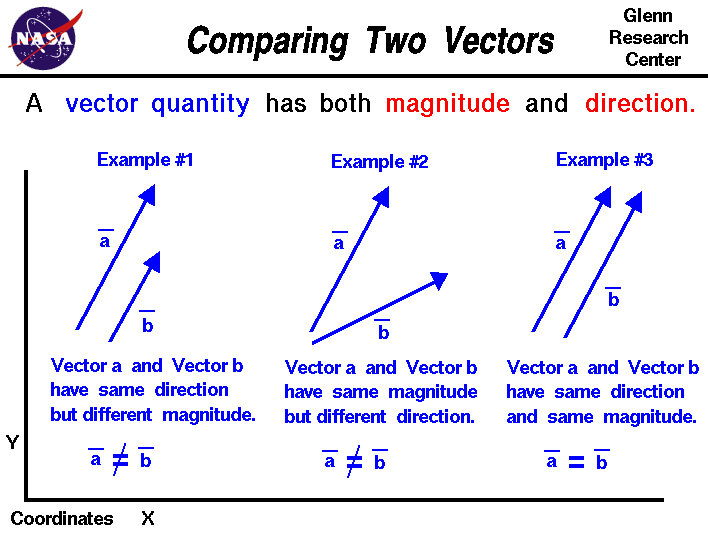
And just to be crystal, allow me to say this again, the 'constant' climb speed statement was more of a test pilot term.. It did not mean they kept it constant down to three decimal places, that is just humanly impossible. What it meant was 'when' you change the IAS during the climb as required, the change should be made as smoothly as possible such that the change in acceleration was kept as small as possible.