
Lt. Walter C. Klank tells his story
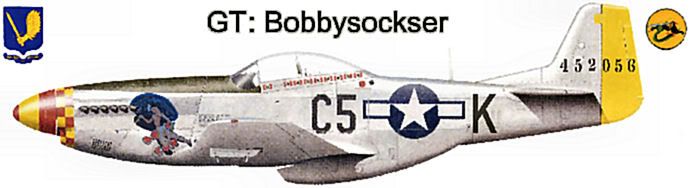
December 24th, 1944, Captain Howard and I were on our way back from a raid. I was flying wingman and we were at 15,000 feet. We spotted four Me-109s at approximately 10,000 feet. Howard shouted lets get 'em and started down still carrying his wing tanks. I yelled back, "Get rid of your tanks." He jettisoned his tanks and I had one hung up. It finally shook loose, but by this time Howard was already tangling with the 109s. I shot down one and then Howard said he got two and was going home. I yelled at him to wait for me - I had been heading east back into Germany and he was becoming a distant speck going west.
My crew chief had mounted a P-38 mirror over my canopy and as I made a swinging turn west I spotted four 109s coming down on my tail. We ended up in a tight turn to the left. My "G" suit allowed me to easily out turn them and soon I was on the tail of number 4, so I decided to add another 109 to the days record. I loosened up on my turn and saw strikes over the engine/cockpit area, the 109 rolled over and pilot bailed out.
About that time I saw holes appearing in my left wing - as the 109 behind me corrected his aim the nose cannon made slashes through the left wing and slugs from his wing guns must have come over the left shoulder of my armor plate - the instrument panel exploded. The slugs must then have dropped down and took out the controls - the 51 flipped over on its back - nose down - no control response - no trim tab response. Reduced throttle and decided to get out. I was hanging upside down with my head almost touching the canopy. I jettisoned the canopy and my arms were sucked out over my head - finally got my right arm back down and flipped safety belt open - I was immediately sucked out of the cockpit.
I apparently struck the vertical stabilizer and was knocked unconscious. My next recollection was falling feet first toward the ground, admiring the brown and white patchwork effect of plowed fields and snow. A small voice said pull the cord - I did - nothing happened - I pulled it again and threw it away. The chute cracked open - the risers jerked me up straight and my feet hit the ground. That's close enough for one lifetime!
Two young soldiers (I recall they were SS) had witnessed the fight and were waiting for me. They immediately went for my shoulder holster and 45 and were very disappointed that I wasn't carrying a gun. My face was bleeding profusely, I assume cut by the exploding instrument panel. My Mae West was soaked in blood and my right arm was useless. I was becoming weak and the two soldiers helped me unbuckle my chute harness and supported me as we made our way toward a narrow road.
I later surmised when I hit the tail my right arm must have scraped along the leading edge of the tail. Days later when I finally was able to remove my clothes I discovered the skin had been stripped from the outer portion of my arm and the arm was firmly attached to the shirt sleeve with dried blood. In a week or so I regained full use of the arm. The facial cuts, particularly above the left eye concerned me and for a while I though I had lost the use of the eye. Once I was able to wash the dried blood out of the eye I was able to see OK.
I had landed in a plowed field and for some reason the two soldiers left my chute there. By this time a group of people from a small village were approaching and in a rather ugly mood. I suspect but for my two captors I might not be writing this. As we reached the road - everyone suddenly dived into the ditches on each side of the road and I was left standing alone. Considering discretion the better part of valor I dove into a ditch also and just in time - a B-17 returning from the raid cut loose three 500 pounders that apparently had hung up. They landed in the plowed field straddling my chute. What a Christmas Eve - shot down and bombed all in one day!
On to the village and into the house of the Burgomaster. The house was crowded with villagers - some seemed "friendly" and emptied my pockets of candy, chewing gum, soap, etc. We had planned to land in Brussels and spend Christmas there, so I had brought along some trading goodies. They were puzzled about my "G" suit hose and kept pulling on it. I finally removed my A-2 jacket and flying suit and gave them the damn thing. I'll never forget the look on their faces, they had no idea what it was. The Burgomaster however, put it away as one of his personal treasures.
I was next loaded into a side car of a motorcycle and taken by a soldier to an MP jail in Frankfurt am Main where I spent Christmas and the next couple of days. No medial attention and boiled potatoes for Christmas dinner. Several days later, a German Lt. and his girl friend took me by staff car with a driver to Dulag Luft. The car appeared to burn wood to produce the fuel or steam for the engine. The roof was piled high with split wood.
I felt stronger at this point and seriously considered escaping by stabbing the Lt. and then the driver. I had not been well searched at the jail and had been able to conceal my boot knife. However, I realized I didn't know how to operate the car, doubtful if the girl did, it was below zero and I really didn't know where I was, so I decided to see it through to the next stop.
We arrived at the Dulag, Dec. 30, 1944, and I was the only one in the room with a German sergeant when I was told to strip. The sergeant paid no attention to me and continued to read a comic book. I thought well one last laugh - I threw my boot knife so that it stuck in the bench next to the sergeant. You have never seen such big eyes or heard such foul language - he spoke English fluently.
Then into solitary in an old 6 ft. x 8 ft. x 10 ft. cell with a blanket too short to cover my feet and shoulders at the same time. I believe I was there about 10 days with frequent interrogations and "role playing" in the cell next to mine. The hauptman that interrogated me spoke fluent English and said he had been raised in Chicago.
Finally off to the train station and on to Stalag Luft I, near Barth, Germany on the Baltic Sea. No one talked for the first day. We all looked at each other with suspicion. Several times the train stopped when fighters flew overhead, the guards got out, but locked us in. Fortunately we were never strafed. The food was meager and greasy, we all had the G.I.'s. What a trip.
Next stop Berlin, and a march through the city and then onto another train. I never understood this transfer but was glad we were surrounded by soldiers. The civilians were ugly and we saw what appeared to be Allied soldiers hanging from lamp posts. Not a pretty sight! The next part of the journey from Berlin to Stalag Luft I, I have no recollection of for some reason.
At Stalag I, we separated, went through a records section, were given blankets and mattress cover, later to be filled with straw, and my A-2, leather jacket was taken and I was given a GI overcoat one size too small. At least it was warmer. I was then taken to the compound that would serve as my home for the next 6 - 7 months, barracks 307, room 2.
Those months were spent in one room with 20 other American flyers. We became good friends, but never got together for the planned reunion in New Orleans. This was a boring time, nothing to do, the library was small so it didn't take long to ready everything. Cold and hungry, we went through the Kriegie trick of cutting up the barracks for firewood, etc. and constantly worked on the drawings and poems in our Kriegie books.
One night our barracks "goon guard" reported the Germans had not locked us in and said they would be gone in the morning because the Russians will be here tomorrow. Liberation at last! I believe it was May 21, 1945. The next morning we were all out early, the guard towers were now manned by GIs and were in effect an Allied camp in German territory.
My buddy Don and I climbed on the roof of our barracks from where we could see Barth's city square in the distance. As I recall around noon a horse drawn caravan arrived led by a horse drawn hansom cab. As the cab reached the center of the square it stopped. The driver slumped forward over the cab, the caravan stopped and the soldiers continued what must have been one long party since they had their women and booze with them.
Finally, after what seemed like hours the door of the cab opened, the colonel (we later learned) stepped out - missed the step and fell flat on his face in the square. No one rushed to his aid, he finally struggled to his feet and apparently barked out orders whereupon the caravan began to act like a military organization. It turned out this was a "unit" of Cossacks. They were dressed in the typical costume with bandoliers of ammo slung across each shoulder. However, they carried stubby machine guns instead of rifles.
Later, we learned through the "grape vine" that the Russian colonel was very upset with us for sitting there in an orderly manner. We should have torn down the fences, raped the women, etc. The Russians threatened to march us down through their lines to the Baltic Sea. Colonel Gabreski, a senior American officer took a firm stand that that was not going to take place. He did however order the fences torn down and a "joint" feast for the next night. The feast went well and we were back in the good graces of the Russians.
The German airfield, close by, contained a concentration camp which we subsequently learned about. That was a gruesome tale, too long to recount here. It also contained booby trapped German planes and an underground buzz bomb factory.
Several days later a caravan of GI trucks picked us up and drove us to an airfield where B-17s loaded with "bug" powder were waiting to take us to decontamination camp. The flight on the 17, my first, in the converted bomb bays, plywood over the bomb doors, is a story in itself. The hydraulic system on the flaps or gear or both failed and we all though - "Oh boy"! Made it through prison camp and now we die in a 17. But we made it.
After decontamination and new clothes we were flown (in my case) by a "hot" pilot in a C-47 to Le Havre, France and settled in Camp Lucky Strike. That's another story in itself. We ate the camp out of food in three days. Almost two weeks had gone by when we discovered our contingent had been "misplaced" by the transportation officer loading Liberty ships with POWs. Under the "stress" of never seeing home again, three of us took off for Paris. After ten days of the sights and sounds of Paris we headed back to Lucky Strike, right up the gang plank of a Liberty ship and a miserable rough trip back to the States. Victor Mature, a movie star, was the Chief Petty Officer in charge of food, and he did his best to make us at home.
German J 2805 reported Lt. Klank captured and aircraft 99% destroyed.
Lt. Klank's postwar statement claimed two Me-109s prior to being shot down and bailing out. On this mission he had been flying with the 3rd Scouting Force, a weather reconnaissance unit stationed at Wormingford which the 55th Fighter Group supported. The 3rd SF did target weather reconnaissance in advance of the bombers.
__________________
|