
more of the arnhem missions..
Captain Arval Roberson leading Dollar (362nd) Green Flight:
"We had been maneuvering in the area south of the Zuider Zee for a short time when the R/T became cluttered with transmissions that only occur when an engagement is in process. After a couple of requests by our leader, someone finally parted with the information as to their location. I don't know if they were just too busy or they didn't want to share the treasure. We rolled out, headed south.
"The first sight of the engagement left one of the strongest impressions of my tour, for it was more like the dogfights that are depicted on artists' canvases and in movies of yesteryear. The scenarios for most of the encounters that I had, involved a stream of bombers being threatened by a gaggle of enemy fighters, who in turn were hit by small groups of escort fighters. The subsequent boiling mass of aircraft would soon spread all over the sky. Often a pilot firing on another aircraft, and/or a wingman covering the one who was firing, could not locate another plane of any kind when climbing back up from the deck or wherever contact had been broken. It is hard to visualize that at one moment there would be aircraft numbering in the hundreds ginning around and then minutes later the sky could be completely devoid of other aircraft.
"However, on this day, although the engagement was the same boiling mass of aircraft, I'd estimate between 30 and 40, the weather was a barrier, containing them in one general area. It seemed as if the cloud cover came up from the deck like a wall on the east to about 20,000 feet where it shelved westward, almost solid, to the coastline. It had a purple to lavender coloring that is association with storm scenes and made the whole area sunless and fairly dim.
"It was the dimness that actually helped me get the first glimpse of the action. Whenever caliber .50 ammo made contact with a solid object, a flash would emanate. In this dim light it was like a strobe and the large amount of flickering that was occurring could be seen like a fireworks display many miles away.
"We checked sights and armament switches and prepared to drop our wing tanks. As we neared the scene, I noticed my No. 4, Lt. Chuck Weaver, was having trouble getting rid of one tank so I veered slightly right to give him more time. I was observing the lead flight diving straight into the middle of that mess, getting strikes while I was ready to tell my No. 3 to take No. 4 away from the action when I saw his tank fall free. (No. 3 was Capt. Jim Kirla.) With this freedom I decided not to barge in with the others but to "street fight" on the outside edge and started to look for a target. I spotted an Me-109 under me going from left to right. I made a diving steep bank and led the gunsight ahead of his nose and fired. I don't think the aircraft I was flying had its guns boresighted in the normal box configuration, for they all seemed to come together on the cockpit. A bad of fire developed where the canopy had been, and I observed black smoke trailing the aircraft as it headed straight toward the ground. I did not see the pilot bail out.
"After checking that Goss was still with me, I looked around for another target. In a matter of seconds I found another 109 that was pulling off an engagement and climbing in front of me. I fired a short burst and observed numerous strikes on his tail. I held fire, pulled more lead through his nose and opened up again. I saw hits on his cowling and the signs of what appeared to be a mixture of smoke and coolant. I kept firing and held this angle until he passed out of sight under my nose. At this time it was necessary to take measures to keep from stalling, which I did by a slight turn to the left (away from the direction the 109 was going) and pushed forward to level out. After gaining some airspeed I banked right to resume the chase. Although I did see a disabled aircraft and some chutes, I did not see my target so I regrouped to find another.
"The next aircraft spotted was another 109 to my left at 10 o'clock in a steep turn to my left. As he was more in line for my wingman, I radioed for him to take him. Either there were transmission problems or too much interference, but Goss made no move toward the 109. I called again and when there was no indication I was getting through, I banked hard left and tried to pull through the Messerschmitt's flight path. We had gone almost 360 degrees around when I felt just a tad more and I would have enough lead to fire. I was so busy trying to get more turn out of my bird that I did not pay attention to a movement in my peripheral vision until I observed strikes all over the German aircraft. At this, I took time to observe a P-51 cutting across our circle and doing a good job of raking the 109. Our converging paths and my being on his belly side, forced me to take immediate evasive action by breaking right.
"When we had collected ourselves we started circling while gaining some altitude. I guess this terminated the action, for all I remember seeing during this time was about six big fires and quite a few smoldering ones on the ground--all grouped in an area of maybe a four-mile radius. Seeing nothing else, we climbed out and picked our average course home.
"Arriving back at Leiston, I did a victory roll before peeling off for landing and then debriefed the ground crew, saying I got one destroyed and one probable. I then headed for squadron ops for the formal debriefing and the 'flying hands' scene that always took place. One of the first persons I saw was Goss, and I made some statement of certainly getting that one and started to ask if he had heard me tell him to take the 109 when he interrupted me: 'What do you mean, the one? You got the other, too!' He started something about shooting the tail off and the pilot bailed out. He, being above and behind, had witnessed all this while I was trying to regain flying speed with the 109 being underneath me.
"After debriefing, I biked back to the hardstand and told the crew chief, 'Stud' Lybarger, to hold on, pending confirmation there would be two kill markings to be painted on." One month later, Roberson's wingman, Charles Goss, was shot down by flak but evaded capture and returned to the UK.
Jerome Jacobs: "I was scheduled for a 48-hour leave on September 19th, and I had a date with a beautiful girl in London. At about 6 a.m. I was awakened and asked to volunteer to fly the mission since one of the pilots was ill. Against my better judgment I dressed, being careful to wear my Class A uniform under my flying suit and reported for briefing.
"About 10 minutes into the mission our No. 3 man had to abort. Twenty minutes or so later we were vectored to bandits, and there were about 500 enemy fighters, the most we had seen since I had been in combat. the three of us quickly picked up three Me-109s; we were turning Lufberry circles in opposite directions. This went on for about three circles until the 109s broke off and we followed. My target turned into me and we faced each other head-on. I fired a long burst and his airplane exploded in front of me. I turned to watch the parts floating down and saw about 15 e/a going in the opposite direction. I called the squadron leader to get some help, but he told me to climb above the cloud to regroup before attacking again. The cloud layer was about 3,000 feet above. I checked my tail and saw 15 e/a now turned behind me.
"I felt that I was out of range and could make the clouds, when suddenly my airplane exploded. the cockpit was full of flames and there were no controls. My face was burnt and I was vaguely aware of what was happening. I bailed out as quickly as I could without even disconnecting my oxygen and other cords. As soon as I hit cool air my face felt a little better. Barely conscious, I thought I was in the clouds already and would wait for my emergence to pull the ripcord. I fell this way for some time before I began to regain my senses and decided to pull the cord. When I did, the chute jerked open and I hit the ground immediately.
"I got out of my chute and started to waddle toward hedges when I saw blood all over me and decided to return for my first- aid kit which was attached to my parachute. It was then that I saw a dozen German soldiers pointing guns at me and motioning me to stop. I couldn't hear them because I hadn't cleared my ears after the long drop (I bailed out at about 19,000 feet).
"I was searched and brought to an army hospital in Emmerick, Germany. My face and left wrist were badly burned and I had wounds on the left knee and forehead. I was at the army hospital for five days until they evacuated, and I was taken into the interior of Germany to POW camp." As happened to many other 8 AF aircrew who made dates with English girls, Jerry Jacobs never kept his date with the beautiful Londoner.
The third man in the ill-fated flight, Lt. Howard Moebius, ( story above) experienced much the same frantic dogfight against heavy odds before being shot down:
"On that day I had the misfortune of having our flight become separated from the group, and one of the wingmen had to abort. The three of us were flying at 10,000 when we were attacked by 35 or 40 German fighters. It all happened so fast I don't recall in which direction my flight leader or the other wingman went. I do know that I ended up with 12 to 14 Germans in a very tight circle. I knew that I was going to see more action than the day before. I opened fire as I closed on the tail of one ship and noticed parts of his plane come off. I did not see him bail out, and the airplane nosed over and dove for the ground. I tightened my turn and got behind a second ship and scored several hits. After a few more turns I got in tighter on him and was able to start his plane on fire.
"In the meantime two or three enemy ships stayed out of the circle and were taking pot shots by making dives at me from head on and right angles. All of a sudden my left wing seemed to explode. The doors on the gun bays popped open and the wing was in flames. I had to decide whether I should roll over and dive for the ground with the possibility of putting out the fire, or whether it would get to the wing tank and explode. We were in a tight right turn and our speed had greatly reduced as we were also fighting for altitude. I pulled the handle that popped the canopy, unfastened my seat belt, and climbed out on the inside of the turn. As I jumped I debated how long I should wait to open my chute. I knew that we were between 16,000 and 20,000 feet, and it would take me considerable time to get down if I opened my chute immediately. I had heard that by opening my chute immediately it would give German search parties every opportunity to locate me before I reached the ground. Since there were airborne troops parachuting into the area, I am sure the Germans would not wait until I hit the ground to open fire. I hung on as long as I could. However, I was spinning so fast that I was afraid I would not be able to judge when I was at 1,500 feet.
For a second it flashed into my mind that Chuck Yeager had said something about opening your arms and that would slow your spin. I opened my arms and my rotation slowed down so I was in a very long 14,000 to 16,000-foot swan dive, and the rush of air was terrific. When I thought I was down to about 1,500 feet I pulled the cord. The little chute popped out, followed by the main, and then it seemed like I just sat in midair.
"It wasn't long before two planes were diving directly at me. It was hard for me to tell whether they were '51s or '190s. However, when they opened fire there was little doubt! I had heard how to dump air from the chute so I reached up, grabbed several shroud lines on one side and pulled my weight up on them. This buckled the chute and allowed me to come down faster. It also spoiled the run that the 109s were making, as their shots must have gone over. (I learned later that they did hit my chute two or three times.) Because I was so close to the ground they did not make a second pass.
"When I was about 50 feet off the ground I realized how rapidly I was descending. I tried to turn so I would be facing the direction toward which I was drifting and could see that I was going to land in a plowed field. The newly plowed field cushioned my fall so I was able to get up immediately. I unfastened my chute, gathered it up, and ran for the edge of the field. However, my G-suit, which was very tight fitting, caused cramps in my legs before I had run 40 yards. I buried my chute and then crawled to a small vegetable garden. I lay for a moment below the leaves in a small rhubarb patch. After what seemed like hours but was probably a few minutes, the cramps left my legs. When I got up in a kneeling position and started to look around, I saw a small boy not more than 40 feet away, motioning for me to get down and pointing toward another field. There I saw a German soldier walking with his gun in the ready position, and I immediately lay down again. I crawled slowly to the edge of the garden where I found a very deep, narrow trench. It was not more than 18 inches wide but it was about three feet deep.
The first thing I did was take off my G-suit, which was quite an operation in such tight quarters. I then lit a cigarette and decided I would just sit there until dark. I could hear a considerable amount of small arms firing in the distance, the heavier concussion of artillery, and intermittent machine gun fire.
"After dark I heard the whistling of the code letter V. At first it did not quite register and I debated whether it was a German or someone who could aid me. Finally I risked sticking my head up and I saw a bout about 20 years old. He was softly saying, 'American pilot, I am your friend,' and he would whistle the letter V three times and repeat, "American pilot, I am your friend.' I decided that since I had my .45 pistol in my hand, I would risk going up to him. He was very calm and cheerful, and said that he would help me."
This was the beginning of five months with the Dutch underground for Howard Moebius. They were months of living everywhere from ditches and shacks to fine country homes, numerous close encounters with German soldiers, artillery, and illness. Finally in February 1945 the Dutch and Belgian underground guided Moebius and two B-26 pilots down the Wahl river to link up with Canadian forces and freedom.
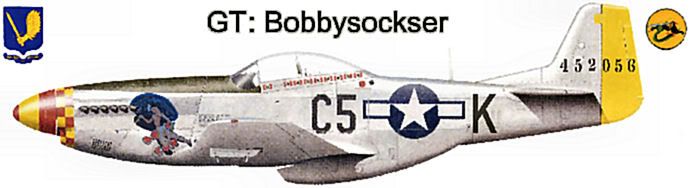
Major Edwin Hiro, the mission leader, flying his P-51D named "Horse's Itch" scored a 109 for his fifth victory. His encounter report was filed by his wingman, Flight Officer Johnnie Carter, as Hiro did not return.
"At about 1720 we were flying at about 13,000 in a direction of south about 10 miles west of Arnhem, we saw about 10 enemy planes engaged in a fight with about 15 of our airplanes. We dropped our tanks and went into a diving turn to the left. I was on Major Hiro's wing when we entered the fight, but was forced to break up and slightly out to avoid hitting a ship coming head-on. Major Hiro made a sharp turn to the left and got on the tail of an enemy ship. There were so many planes in the Lufberry that I had to pull out and over to get back in position on Major Hiro's wing.
"About this time the plane that I thought was Major Hiro broke out and headed for the deck on the tail of a 109. I took out after him and tried to catch them. I followed them all the way to the deck and saw the 109 crash in flames. Major Hiro pulled up into a steep chandelle and got in with a bunch of other ships that were still milling around. Due to my being quite a ways behind and in poor visibility when I joined up with one of these ships, I had gotten the wrong ship. I broke off immediately and tried to find my position but there were so many in the area that I was unable to find Major Hiro.
"About this time I heard him call our flight and ask our position, and tried to give his own. There was so much talk on the radio that we could not get each other's position. About this time, recall was given and I thought my best bet was to stay with the ships in the area to come home. I joined one of the flights and returned to base. When I landed I found that Major Hiro had not returned."
Luftwaffe reports attached to Hiro's Missing Aircrew Report tell us that a Mustang crashed at Ahaus (a village 38 miles west of Arnhem), shot down by a fighter. The pilot was dead and was buried in a Catholic cemetery, Vreden, grave No. 11.
Forty-one years later, almost to the day, this writer heard a postscript on the loss of Edwin Hiro and James Blanchard. During a conversation with 362nd Squadron pilot Ted Conlin, he gave me his memories:
"Jim Blanchard was my wingman that day and I think Capt. Williams was leading Dollar Squadron. When we arrived in the area we heard considerable chatter on the R/T, probably Major Hiro and his squadron. Just as we dropped our tanks we were bounced by 109s that came out of the sun and cloud cover. A 109 being chased by a '51 went across my nose, but the '51 had a 109 on his ass so I rolled into attach headed straight down. As I closed on the 109 I took cannon fire on my left side. I had to break off to handle my problem. It was that moment when my wingman, Blanchard, was shot down. I had thought at the time that Major Hiro was the P-51 and I tried to relocate him and Blanchard. After several minutes the enemy broke away and we returned to base. I then gave my account at debriefing and I am certain Major Hiro was the man in the middle of that attack."
During the two days of intense combat on the 18th and 19th, claims for the destruction of 50 Me-109s and FW-190s were turned in, plus a probable and two damaged. Seven Mustangs were lost with three pilots dead, three prisoners, and one evader. The Yoxford Boys' eventful participation in Operation Market-Garden was over.
__________________
Last edited by bobbysocks; 10-18-2010 at 03:23 AM.
|